

Attack vs. Transport: How the AH-64 Apache and UH-60 Black Hawk Complement Modern Warfare
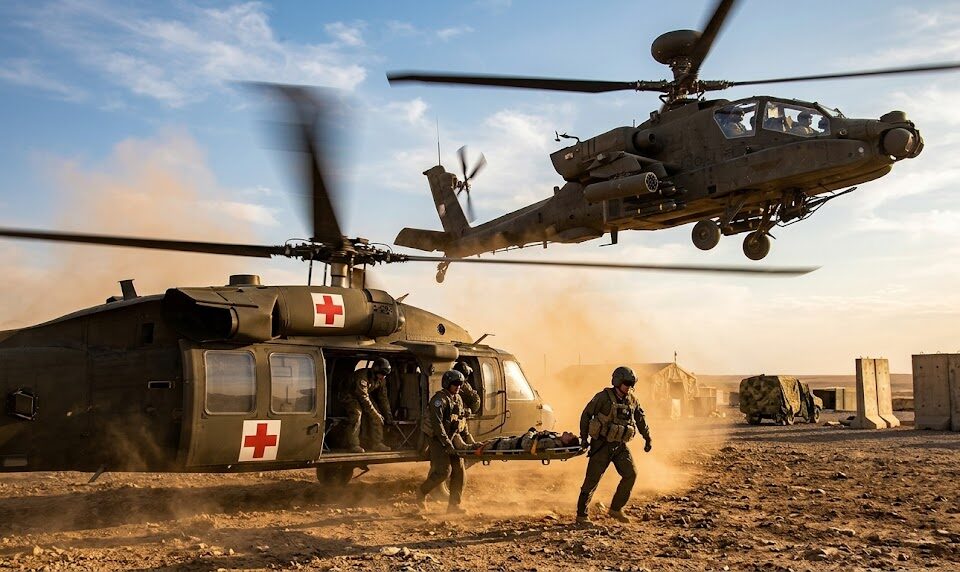
Two of the most iconic military helicopters ever built share the same airspace but serve entirely different purposes. One was engineered to destroy hardened targets at standoff range, while the other was built to put boots on the ground and bring the wounded home. The Apache vs. Black Hawk debate rarely produces a winner because these aircraft were never designed to compete; they were designed to work together. Learn how these helicopters complement each other, from combat capabilities and battlefield synergy to the ground support that keeps them ready when every mission counts. The AH-64 Apache, Born to Attack The Apache is a purpose-built attack platform with no utility function. Every design decision reflects one mission: find and destroy enemy armor, vehicles, and fixed positions. Origins and Development of the Apache Attack Helicopter Developed under the Army’s Advanced Attack Helicopter program to replace the AH-1 Cobra, the AH-64 entered service in 1984. The platform has evolved through the AH-64D Longbow to the current AH-64E Guardian, adding digital connectivity, improved sensors, and expanded weapons integration with each generation. Primary Mission Role: Precision Strike and Armed Reconnaissance Destroying armor, vehicles, and fixed positions is the Apache’s primary job, executed at ranges that keep the crew outside the most dangerous threat envelopes. Every pound of capacity is dedicated to weapons, fuel, and survivability. The Apache carries no passengers, focusing solely on firepower and survivability. Key Weapons Systems and Combat Capabilities The M230 30mm chain gun, slaved to the pilot’s helmet-mounted display, forms the backbone of Apache firepower. AGM-114 Hellfire missiles defeat main battle tank armor at ranges exceeding 8 kilometers, while 70mm Hydra rockets handle area suppression. The Longbow radar detects and classifies up to 256 targets simultaneously, and the FLIR and TADS suite supports effective operations at night and in degraded visibility. Where the Apache Has Proven Itself in Combat AH-64s fired the opening shots of Operation Desert Storm in 1991, destroying Iraqi radar installations to clear corridors for coalition aircraft. Now in its E Guardian variant, the Apache serves the U.S. Army and more than a dozen allied nations after sustained combat in Iraq and Afghanistan. The UH-60 Black Hawk, The Backbone of Troop Transport Where the Apache concentrates on a single mission, the Black Hawk is designed to be useful across many. Air assault, medical evacuation, logistics, and special operations support all fall within its scope. Origins and Development of the Black Hawk Utility Helicopter Sikorsky developed the UH-60 to replace the UH-1 Iroquois, and it entered service in 1979. Designed to fit inside a C-130 Hercules, the aircraft featured crashworthy crew seats, redundant hydraulics, and a rotor system rated to sustain 23mm hits. Primary Mission Role: Troop Transport, MEDEVAC, and Logistics Air assault is the Black Hawk’s core function, lifting an 11-man rifle squad into a landing zone, but the platform extends readily into medical evacuation, command and control, and logistics resupply. The HH-60M MEDEVAC variant can carry up to six litter patients, and its export to more than 30 countries highlights the global value of this versatility. Key Systems and Operational Versatility Two GE T700-GE-701D engines producing approximately 1,940 shaft horsepower each enable single-engine flight at maximum gross weight. The External Stores Support System (ESSS) allows 230-gallon fuel tanks or weapons pylons, though neither configuration approaches the Apache’s dedicated firepower. Where the Black Hawk Has Proven Itself Across Global Operations Combat service began in Grenada in 1983 and continued through the Gulf War, Somalia, Bosnia, Iraq, and Afghanistan. Structural resilience was demonstrated at Mogadishu in 1993, where crew members survived RPG strikes that would have destroyed less robust platforms. Black Hawk vs. Apache Helicopter: Key Differences Side by Side When comparing Black Hawk vs. Apache helicopter specifications, the differences are stark and deliberate. Each reflects a completely different mission design, visible across every performance parameter. Size, Weight, and Performance Specifications Specification AH-64E Apache UH-60M Black Hawk Primary Role Attack / Armed Recon Transport / Utility Crew 2 (Pilot + CPG) 2–4 Max Takeoff Weight ~23,000 lbs ~22,000 lbs Max Speed ~182 mph ~183 mph Combat Range ~300 miles ~368 miles Engines 2x GE T700-GE-701D 2x GE T700-GE-701D Troop Capacity None Up to 11 troops Crew Requirements and Cockpit Design The Apache’s tandem cockpit seats a pilot in the rear and a co-pilot/gunner in the front, with full controls at both stations, armored and built around weapons employment. Optimized for landing zone awareness, the Black Hawk’s side-by-side configuration supports two pilots, a crew chief, and mission-dependent personnel. Armament and Defensive Systems Compared The Apache carries the M230 chain gun, Hellfire missiles, and Hydra rockets. Standard Black Hawk configuration carries no offensive armament, though M240 machine guns and M134 miniguns are common in combat deployments. Operational Range and Payload Differences Apache payload is almost entirely weapons and fuel, with no cargo and no passengers. The Black Hawk carries up to 9,000 lbs externally, 11 troops internally, or six litter patients in MEDEVAC configuration, using auxiliary fuel tanks for extended range where the Apache relies on FARPs. Apache Helicopter vs. Black Hawk The real operational picture of Apache helicopter vs. Black Hawk is not a competition. It is a partnership embedded in U.S. Army air assault doctrine, essential to modern helicopter operations. The Attack-Transport Tandem in Modern Air Assault Operations Modern air assault integrates attack and utility helicopters into a single synchronized package. Black Hawks lift the assault force while Apaches clear, suppress, and protect the approach. Neither achieves the mission alone: attack without transport produces tactical success with no force to exploit it, and transport without suppression risks losing the assault force before reaching the objective. How Apaches Provide Escort and Fire Support for Black Hawk Missions In a standard air assault, Apaches fly ahead of the Black Hawk formation, engaging air defense positions and suppressing the landing zone before the first utility helicopter arrives. Once troops are on the ground, Apaches remain on station for on-call fire support, extending combat power well beyond what the dismounted force could