

Bell Helicopter Models, Military Variants & Ground Power: The Mechanic’s Complete Guide
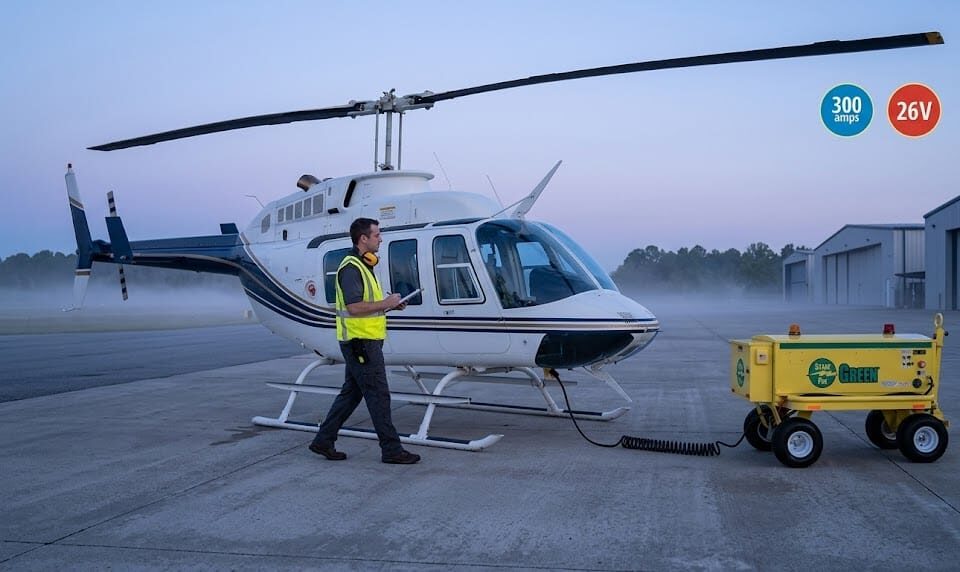
Ground power is where maintenance sessions start. For mechanics working on Bell helicopters, the consequences of getting it wrong run deeper than a tripped breaker. A poorly regulated supply during avionics initialization can plant fault codes that take the better part of a shift to trace. An undersized unit can fail mid-sequence. Neither outcome fits a tight turnaround. This guide is written for the people who keep aircraft flying: mechanics, MRO technicians, FBO ground crews, and military maintainers who service Bell platforms day in and day out. It covers the full Bell fleet (commercial and military), the ground power requirements that keep those aircraft mission-ready, and the equipment decisions that matter most when lives and schedules are on the line. START PAC, with over 27 years of experience supporting helicopter operators globally, is the resource behind this guide. Bell Helicopters: A Brief Overview No single GPU specification covers the entire Bell fleet. That is the practical reality mechanics encounter when standardizing ground support equipment across mixed Bell operations. Bell has built its reputation over more than eight decades as one of the most recognized names in rotorcraft. Now operating as Bell Textron under the Textron corporate umbrella, the company produces aircraft for virtually every operational environment: corporate transport emergency medical services law enforcement, offshore energy agricultural aviation military operations Bell helicopters do not share identical servicing requirements across the lineup. A single-engine turbine helicopter used for flight training operates under very different ground power considerations than a twin-engine military utility platform. The fleet is diverse by design. Ground support decisions need to reflect that diversity, not assume that one approach covers everything. Bell Helicopter Models in Active Service The commercial Bell helicopter models in active service span multiple performance tiers and operational categories. Bell 407 Single-engine and high-cycle, the Bell 407 is a staple of law enforcement, EMS, and utility operations. It is among the most frequently serviced light turbines at North American FBOs and MROs, and its ground power requirements are well understood by experienced mechanics. Bell 412 Offshore energy transport, search and rescue, and military utility roles define the Bell 412’s operational world. Bell 412 ground support is more power-intensive than lighter platforms, reflecting its larger avionics suite and dual-engine electrical systems. Bell 429 The Bell 429 occupies the light twin category with a full glass cockpit and digital avionics architecture. Glass-panel platforms are particularly sensitive to power quality during systems initialization. Correct helicopter maintenance on the 429 begins before a single panel switch is touched. It begins with the quality of the power source. Bell 505 The Bell 505 JetRanger X is the newest light single in the lineup, designed for training and light utility. Its avionics architecture assumes clean, regulated external power from the start. It does not absorb voltage instability the way older airframes sometimes did. Bell 206 The Bell 206 JetRanger, though no longer in production, remains widespread in training and utility fleets globally. Mechanics maintaining legacy platforms alongside newer models need to account for the difference in ground support requirements between generations. Bell Military Helicopters The Bell military helicopter lineup spans decades of service, from Cold War icons still flying today to next-generation programs shaping the future of rotary-wing combat. UH-1 Iroquois: Introduced during the Vietnam era, still in active service with militaries around the world. AH-1Z Viper: The U.S. Marine Corps’ current frontline attack helicopter. OH-58 Kiowa: Filled the U.S. Army’s reconnaissance role for decades before its retirement. V-22 Osprey: A tiltrotor platform co-developed with Boeing, operated by U.S. Special Operations Forces and the Marines. 360 Invictus: Bell’s candidate for the Army’s Future Attack Reconnaissance Aircraft (FARA) program. Ground Support in Military Environments Servicing military helicopters is a fundamentally different challenge from helicopter operations. Forward operating conditions, austere infrastructure, and relentless operational tempo place demands on ground support equipment that standard commercial GPUs are simply not built to meet. On platforms like the AH-1Z, avionics initialization requires precise power sequencing; there is no margin for error. In forward environments, technicians cannot afford to spend a morning tracing fault codes that should never have appeared. Ground support equipment in these settings must perform without exception, every single time. Where Are Bell Helicopters Manufactured? Bell’s primary manufacturing footprint is in Texas. The company’s headquarters and main production operations are based in Fort Worth. Final assembly for several military programs, including the V-22 Osprey in a joint program with Boeing, is conducted in Amarillo. Where are Bell helicopters manufactured beyond the United States? Bell operates a production and completion facility in Mirabel, Quebec, supporting commercial helicopter production for international markets. Service centers and completion facilities across multiple countries extend Bell’s support network to operators worldwide, meaning mechanics servicing Bell platforms exist on every continent, operating under conditions Bell’s production standards were designed to anticipate. For mechanics, that manufacturing consistency carries a direct implication. Aircraft built to tight, certified production standards perform best when the ground support equipment servicing them is held to an equivalent level of quality and precision. Bell’s engineering discipline does not end at the production line. Ground Power Requirements: What Mechanics Need to Know Most turbine helicopters in the Bell commercial fleet operate on 28VDC as their primary external power standard. The specification is only part of the picture. What matters is that power delivered during ground operations remains clean, regulated, and within tolerance throughout the entire service sequence without interruption. Bell helicopter maintenance procedures specify connection and disconnection sequences for a reason. Connecting external power while cockpit switches are in the wrong configuration, or disconnecting before systems have properly de-energized, generates fault codes and avionics resets that show up in maintenance write-ups. They create downstream work. That work takes time neither the aircraft nor the operator has. For helicopter avionics power on glass-panel platforms, the draw occurs across multiple buses simultaneously during initialization. A ground power unit that can’t hold steady output voltage through that startup sequence will produce anomalies that are time-consuming to diagnose and easy to misattribute. Voltage