
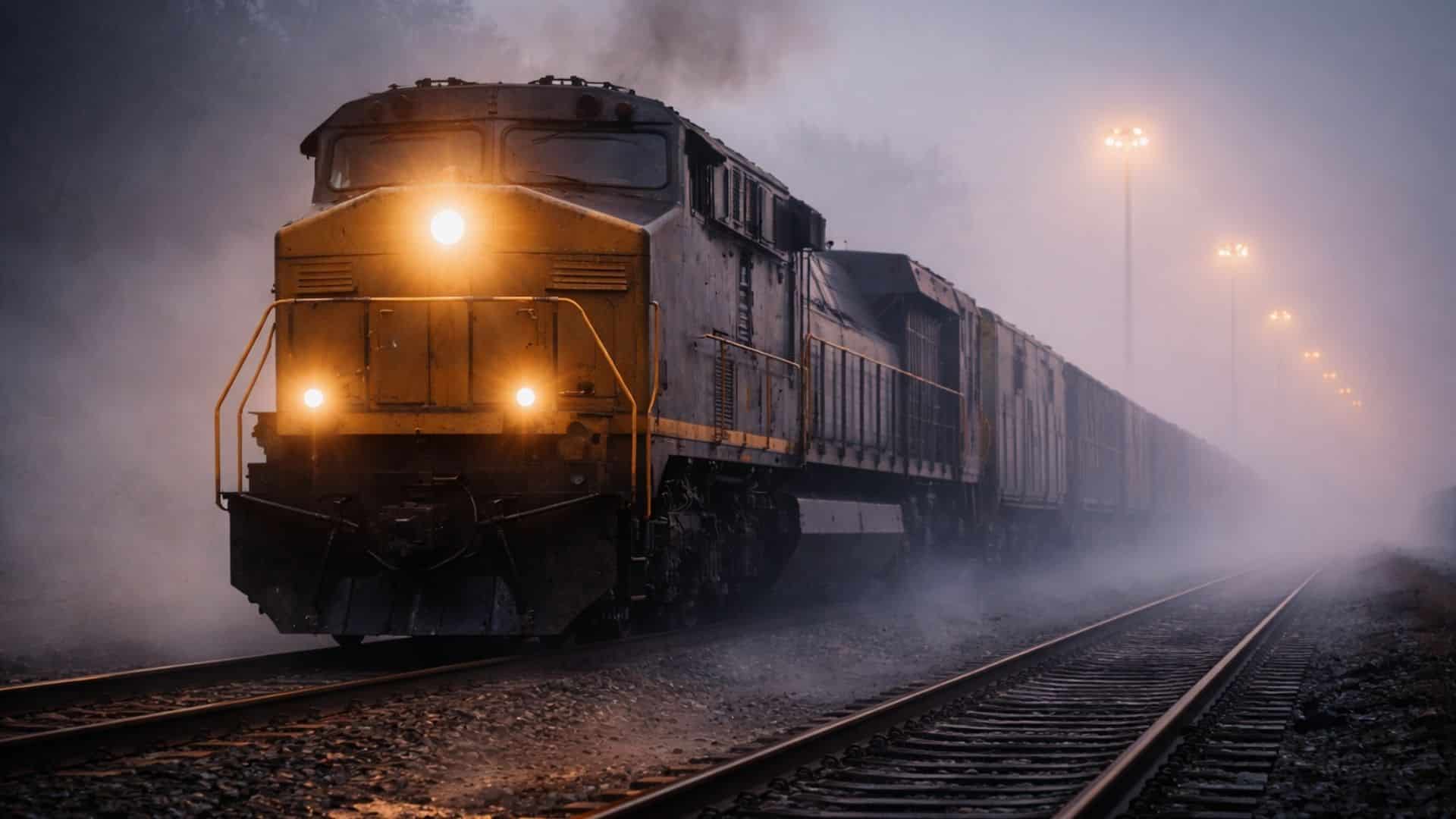
Trains move more cargo with less energy than almost any other form of land transportation. Steel wheels rolling on steel rails create far less resistance than rubber tires on asphalt. That core advantage explains why one locomotive can haul thousands of tons across entire continents.
So, how do trains work? At the most basic level, they convert energy into motion along a guided, low-friction track. But modern rail propulsion goes far beyond simple mechanics. Today’s rail networks blend power electronics with algorithmic traction control in ways engineers from a few decades ago wouldn’t recognize.
Power Sources Used in Modern Rail Operations
Every rail system starts with a basic question: where does the power come from? Diesel, electric, and hybrid configurations each serve different needs.
Diesel fuel dominates North American and Australian freight operations. It packs roughly 35.8 MJ/L of energy, letting locomotives run over 1,000 miles without refueling. That range matters in remote territory where stringing electrical wires would cost a fortune. But diesel engines achieve only 30–35% thermal efficiency, and the rest escapes as waste heat before even reaching the wheels.
By comparison, grid electricity delivered via overhead catenary systems offers higher drivetrain efficiency. High-voltage AC power (typically 25 kV or 15 kV) minimizes transmission losses.
The wire-to-wheel efficiency of an electric train’s drivetrain can reach around 95%. True well-to-wheel efficiency, which includes losses at power plants and in transmission lines, ranges from 25–50% depending on how the electricity is generated. Still, that beats diesel’s thermal efficiency, which is why electrification appeals to high-density corridors.
Then, there are hybrids. In January 2025, Canadian National launched a pilot program pairing a diesel prime mover with a 2.4 MWh battery system. The batteries handle the high-torque demands of starting heavy trains while the diesel engine runs at steady, efficient baselines. The system also captures braking energy that would otherwise dissipate as heat. CN reports this setup targets a 50% reduction in fuel consumption for yard operations.
Locomotive Propulsion and Power Conversion

Here’s a common misconception: diesel engines turn train wheels directly. They don’t. Connecting a diesel engine mechanically to wheels hauling 15,000 tons would require impossibly large transmissions. Instead, modern locomotives use electrical transmission. How does a train engine work under this setup? Through a chain of energy conversions.
First comes the prime mover, a massive diesel engine with 12 to 16 cylinders. The crankshaft spins a main alternator, generating alternating current. That AC hits a rectifier bank, converting it to stable direct current, typically on the order of several hundred to over a thousand volts, depending on locomotive design. Inverters then switch the DC on and off thousands of times per second to synthesize new AC waveforms, using variable voltage variable frequency control to govern traction motor speed and torque with extreme precision.
That covers how a single locomotive generates tractive effort. But what happens when one isn’t enough? This is where the distinction between locomotive vs train becomes operationally important. A locomotive contains propulsion machinery but carries no payload. A train refers to the entire coupled consist, including unpowered rolling stock that can stretch over two miles.
Pulling all that mass from the front alone puts enormous tension on couplers. The solution is distributed power: locomotives placed at the head, middle, and rear-of-consist. These remote units communicate via encrypted radio telemetry, synchronizing throttle commands instantly to reduce coupler stress.
Wheel-Rail Interaction and Traction Efficiency
All that precisely controlled power means nothing if wheels can’t grip the rails. Low friction is rail transport’s core advantage and its greatest engineering challenge. How do trains pull massive loads without wheels spinning on smooth rails? It comes down to adhesion and creep.
Wheel-rail interaction isn’t simple static friction. Optimal traction actually occurs when wheels spin slightly faster than the train moves, typically a micro-slip of 1–2% under dry, clean rail conditions. In this state, steel surfaces interlock at a microscopic level, and friction peaks.
Modern control systems monitor every wheel by the millisecond. When a wheel starts slipping beyond optimal thresholds, inverters instantly cut power to that specific axle. Each axle gets its own control loop.
Physical conditions impose hard limits. Wet rails, ice, or leaf mulch (which creates a slippery pectin layer) cut adhesion fast. In response, locomotives fight back with sanding systems. Silica sand blasts in front of the wheels, crushes under pressure, and temporarily restores grip. Bad weather still wins sometimes.
Guidance, Stability, and Track Geometry

How do trains work without steering wheels? They steer themselves through geometry.
Train wheels aren’t perfect cylinders. They taper conically, smaller on the outside and larger near the inside flange. When centrifugal force pushes a wheelset toward the outer rail in a curve, the outside wheel rides on its larger diameter while the inside wheel rides on its smaller diameter.
Both wheels share a solid axle rotating at identical angular velocity, so the outer wheel covers a greater distance per revolution. The axle steers itself into the curve. Push the speed high enough, and this self-centering breaks down into side-to-side oscillation that engineers call hunting motion.
Suspension keeps the train’s weight from pounding the track apart. Primary suspension sits between axle bearings and bogie frames, absorbing high-frequency vibrations. Secondary suspension goes between bogie frames and car bodies, handling slower swaying motions and keeping ride height level regardless of passenger load.
Equally important, track geometry must be precise. Standard gauge keeps 1,435 mm between rails, maintained within millimeters. On curves, the outer rail sits higher than the inner rail. This superelevation banks the track like a racetrack, fighting centrifugal force and spreading load so both rails wear evenly.
Train Control, Signaling, and Safety Systems
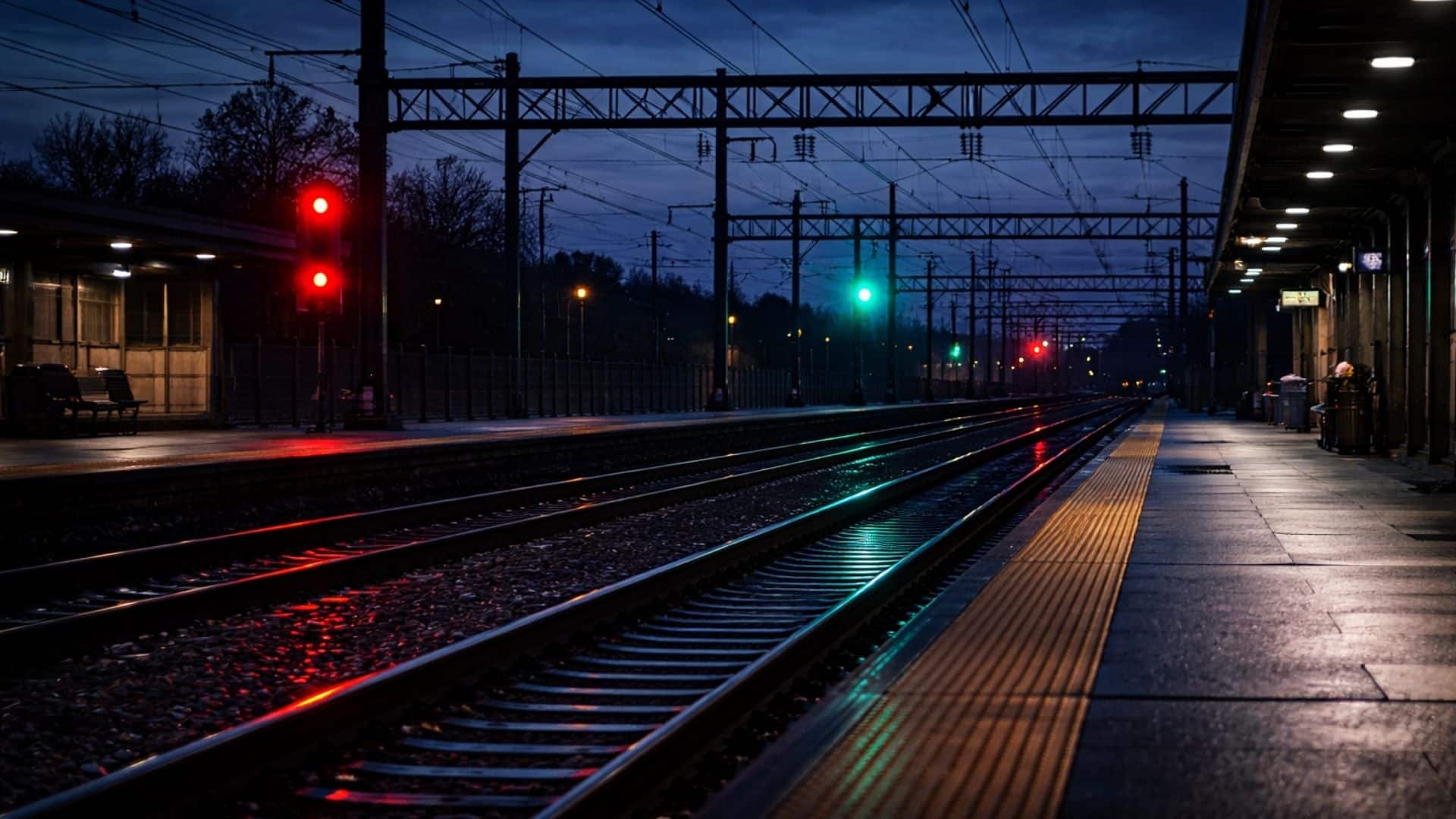
Trains can’t steer around obstacles, and a fully loaded freight train can take over a mile to stop. Safety depends on external control systems that have evolved significantly.
Traditional block signaling divided tracks into sections, permitting only one train per block. Centralized Traffic Control (CTC) improved on this by consolidating signals and switching authority into dispatch centers, letting operators view and route trains across entire subdivisions remotely. However, both depended on crews obeying what they saw.
Positive Train Control (PTC), now federally mandated on major US railroads, took compliance out of the equation. GPS tracks each train’s position. An onboard computer knows the train’s weight, the track ahead, and the stopping distance math. If the crew doesn’t brake in time, PTC does it for them.
More broadly, the industry classifies automation in grades. Where your transit system falls on this, scale shapes everything from staffing costs to how quickly it can respond when something goes wrong:
- GoA 1: Driver controls acceleration; protection systems prevent collisions
- GoA 2: Automated driving; attendant handles doors
- GoA 3: Driverless with onboard attendant
- GoA 4: Fully unattended (e.g., Vancouver’s SkyTrain)
Most legacy rail sits at GoA 1 or 2. New metro builds increasingly target GoA 3 and 4, betting that the upfront infrastructure cost pays off in decades of reduced labor expenses and tighter headways.
Braking Systems and Energy Management
Stopping 20,000 tons is harder than starting it. Modern trains rely on redundant pneumatic and dynamic systems working together.
The Westinghouse automatic air brake, invented on April 13, 1869, remains the universal safety standard. Its genius lies in a fail-safe design. A continuous pipe carrying 90 psi compressed air runs the train’s length. Unlike cars, where pressing the pedal adds brake pressure, train brakes are held released by high pipe pressure. Reducing pressure applies brakes. This matters because if the train separates, disconnected air hoses instantly drop pressure to zero, and every car automatically applies emergency brakes. A runaway train stops itself.
Dynamic braking reverses electrical connections to traction motors, converting them to generators. The momentum-driven rotation creates magnetic resistance that slows the train. With standard diesel-electric drive, this generated electricity feeds rooftop resistor grids, dissipating as waste heat.
By contrast, electric trains and modern hybrids do something smarter. They convert dynamic braking into regenerative braking, returning generated electricity to overhead catenaries for other trains or storing it in onboard batteries. Recovery rates vary by service type. Metro systems with frequent stops can recover up to 30% of energy, while long-distance and freight trains recover considerably less due to fewer braking events.
How Do Steam Trains Work
How do steam trains work? They burn fuel to boil water. The steam expands, shoves pistons, and the pistons turn the wheels. Simple concept, but the machinery to pull it off filled entire locomotive cabs.
The steam engine boiler is where it starts. Fuel burns in a firebox at one end. Hot gases snake through tubes surrounded by water until that water flashes to high-pressure steam. The steam shoots into cylinders, drives pistons back and forth, and a system of rods translates that motion into wheel rotation. Valve gear controls steam timing, letting the engineer reverse the train and adjust efficiency while cruising.
But how do steam trains work efficiently? They don’t. Typical steam locomotives achieved only 6–10% thermal efficiency, meaning 90% of fuel energy escaped as waste heat and exhaust. Compare that to diesel’s 30–35% or electric’s roughly 95% drivetrain efficiency. Steam also demanded intensive maintenance and extensive water infrastructure. The economics made continued operation unviable.
How Do Electric Trains Work
How do electric trains work without onboard engines? They function as motors connected to remote power plants via flexible electrical umbilicals.
Electricity arrives through pantographs sliding along overhead wires or contact shoes on third rails. In AC systems, main transformers step down high-voltage (25 kV) to levels suitable for traction converters. Power then follows the familiar path: rectification to DC, inversion to controlled AC, and delivery to traction motors.
Notably, the key advantage is short-term rating. Diesel engines have hard horsepower limits, but electric trains can draw grid power well beyond continuous ratings for acceleration bursts. Electric traction works best for high-speed rail and commuter systems with frequent stops. Zero point-of-use emissions add another benefit.
How do electric trains work on non-electrified lines? Battery electric multiple units (BEMUs) like the Stadler FLIRT Akku operate on catenary while charging batteries, then switch to battery power where wires end. Current specs show 150 to 185 km ranges on battery alone with roughly 20-minute recharging. These battery-powered trains fill gaps in electrification without reverting to diesel.
How Do Maglev Trains Work

How do maglev trains work without wheels? Magnetic levitation ditches wheels entirely. No wheel-rail contact means friction and wear drop to nearly zero.
- Electromagnetic suspension (EMS): German Transrapid systems use electromagnets beneath the train that pull upward toward steel guideways. Electronics adjust the 10 mm gap thousands of times per second.
- Electrodynamic suspension (EDS): Japan’s SC Maglev works on repulsion instead. Superconducting magnets induce currents in guideway coils that push back. At low speeds the effect is too weak, so the train rolls on rubber tires until hitting about 150 km/h. Then it floats.
Once floating, how do maglev trains work to move forward? Linear motors, essentially conventional motors unrolled flat, line the guideway. Alternating magnetic fields in track coils pull the train forward without moving parts, enabling speeds exceeding 600 km/h. The physics work, but the economics remain challenging. Japan’s Chuo Shinkansen maglev project has faced significant cost overruns and delays.
Conclusion
As the industry electrifies and automates, how do trains work going forward? The same basic way, just smarter. Steel still rolls on steel, exploiting far lower rolling resistance than rubber on asphalt. That single advantage explains why one locomotive hauls what would require dozens of trucks.
What’s changed is how tightly we control that advantage. Millisecond traction control prevents wheel slip that once limited pulling power. Regenerative braking recovers energy that older systems threw away as heat. PTC enforces safety margins that human attention sometimes misses.
Rail already moves a ton of cargo 500 miles on a single gallon of diesel. Electrification, hybrid powertrains, and battery technology push that efficiency further while eliminating local emissions. The industry that once symbolized industrial-age pollution is becoming one of the cleanest ways to move mass across land.
The basic locomotive mechanics remain: steel wheel on steel rail. Everything around them keeps getting smarter.