
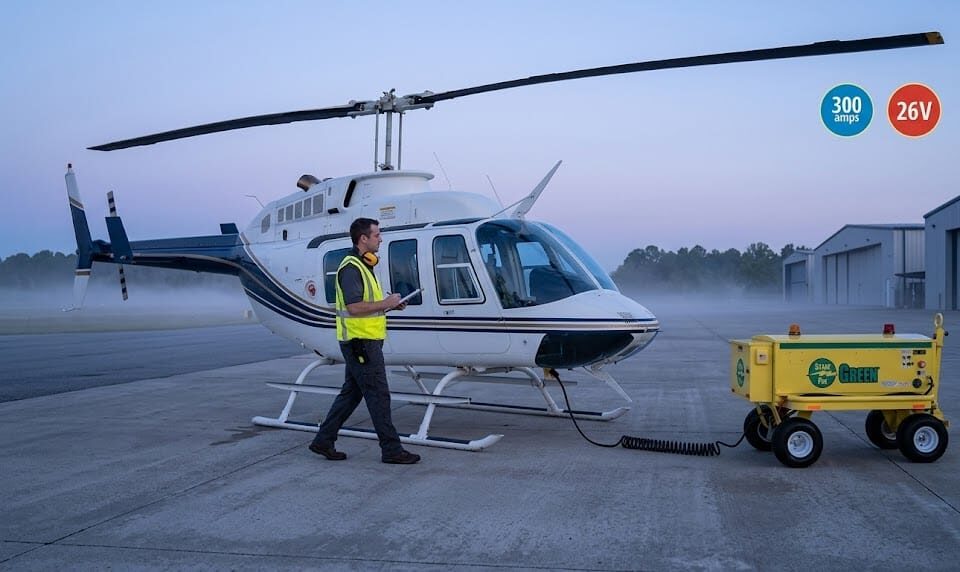
Ground power is where maintenance sessions start. For mechanics working on Bell helicopters, the consequences of getting it wrong run deeper than a tripped breaker. A poorly regulated supply during avionics initialization can plant fault codes that take the better part of a shift to trace. An undersized unit can fail mid-sequence. Neither outcome fits a tight turnaround.
This guide is written for the people who keep aircraft flying: mechanics, MRO technicians, FBO ground crews, and military maintainers who service Bell platforms day in and day out. It covers the full Bell fleet (commercial and military), the ground power requirements that keep those aircraft mission-ready, and the equipment decisions that matter most when lives and schedules are on the line.
START PAC, with over 27 years of experience supporting helicopter operators globally, is the resource behind this guide.
Bell Helicopters: A Brief Overview
No single GPU specification covers the entire Bell fleet. That is the practical reality mechanics encounter when standardizing ground support equipment across mixed Bell operations.
Bell has built its reputation over more than eight decades as one of the most recognized names in rotorcraft. Now operating as Bell Textron under the Textron corporate umbrella, the company produces aircraft for virtually every operational environment:
- corporate transport
- emergency medical services
- law enforcement, offshore energy
- agricultural aviation
- military operations
Bell helicopters do not share identical servicing requirements across the lineup. A single-engine turbine helicopter used for flight training operates under very different ground power considerations than a twin-engine military utility platform. The fleet is diverse by design. Ground support decisions need to reflect that diversity, not assume that one approach covers everything.
Bell Helicopter Models in Active Service
The commercial Bell helicopter models in active service span multiple performance tiers and operational categories.
Bell 407
Single-engine and high-cycle, the Bell 407 is a staple of law enforcement, EMS, and utility operations. It is among the most frequently serviced light turbines at North American FBOs and MROs, and its ground power requirements are well understood by experienced mechanics.
Bell 412
Offshore energy transport, search and rescue, and military utility roles define the Bell 412’s operational world. Bell 412 ground support is more power-intensive than lighter platforms, reflecting its larger avionics suite and dual-engine electrical systems.
Bell 429
The Bell 429 occupies the light twin category with a full glass cockpit and digital avionics architecture. Glass-panel platforms are particularly sensitive to power quality during systems initialization. Correct helicopter maintenance on the 429 begins before a single panel switch is touched. It begins with the quality of the power source.
Bell 505
The Bell 505 JetRanger X is the newest light single in the lineup, designed for training and light utility. Its avionics architecture assumes clean, regulated external power from the start. It does not absorb voltage instability the way older airframes sometimes did.
Bell 206
The Bell 206 JetRanger, though no longer in production, remains widespread in training and utility fleets globally. Mechanics maintaining legacy platforms alongside newer models need to account for the difference in ground support requirements between generations.
Bell Military Helicopters
The Bell military helicopter lineup spans decades of service, from Cold War icons still flying today to next-generation programs shaping the future of rotary-wing combat.
- UH-1 Iroquois: Introduced during the Vietnam era, still in active service with militaries around the world.
- AH-1Z Viper: The U.S. Marine Corps’ current frontline attack helicopter.
- OH-58 Kiowa: Filled the U.S. Army’s reconnaissance role for decades before its retirement.
- V-22 Osprey: A tiltrotor platform co-developed with Boeing, operated by U.S. Special Operations Forces and the Marines.
- 360 Invictus: Bell’s candidate for the Army’s Future Attack Reconnaissance Aircraft (FARA) program.
Ground Support in Military Environments
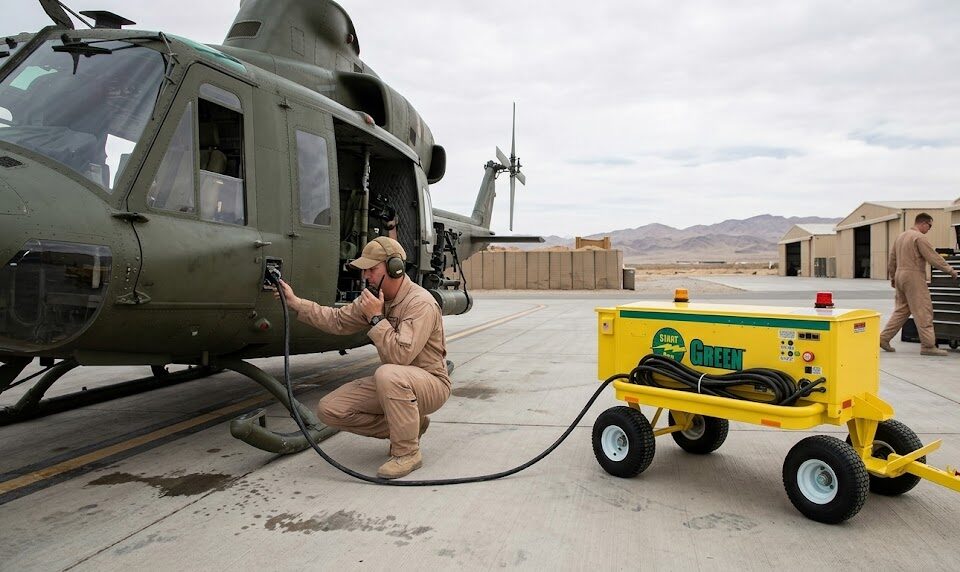
Servicing military helicopters is a fundamentally different challenge from helicopter operations. Forward operating conditions, austere infrastructure, and relentless operational tempo place demands on ground support equipment that standard commercial GPUs are simply not built to meet.
On platforms like the AH-1Z, avionics initialization requires precise power sequencing; there is no margin for error. In forward environments, technicians cannot afford to spend a morning tracing fault codes that should never have appeared. Ground support equipment in these settings must perform without exception, every single time.
Where Are Bell Helicopters Manufactured?
Bell’s primary manufacturing footprint is in Texas. The company’s headquarters and main production operations are based in Fort Worth. Final assembly for several military programs, including the V-22 Osprey in a joint program with Boeing, is conducted in Amarillo.
Where are Bell helicopters manufactured beyond the United States? Bell operates a production and completion facility in Mirabel, Quebec, supporting commercial helicopter production for international markets.
Service centers and completion facilities across multiple countries extend Bell’s support network to operators worldwide, meaning mechanics servicing Bell platforms exist on every continent, operating under conditions Bell’s production standards were designed to anticipate.
For mechanics, that manufacturing consistency carries a direct implication. Aircraft built to tight, certified production standards perform best when the ground support equipment servicing them is held to an equivalent level of quality and precision. Bell’s engineering discipline does not end at the production line.
Ground Power Requirements: What Mechanics Need to Know
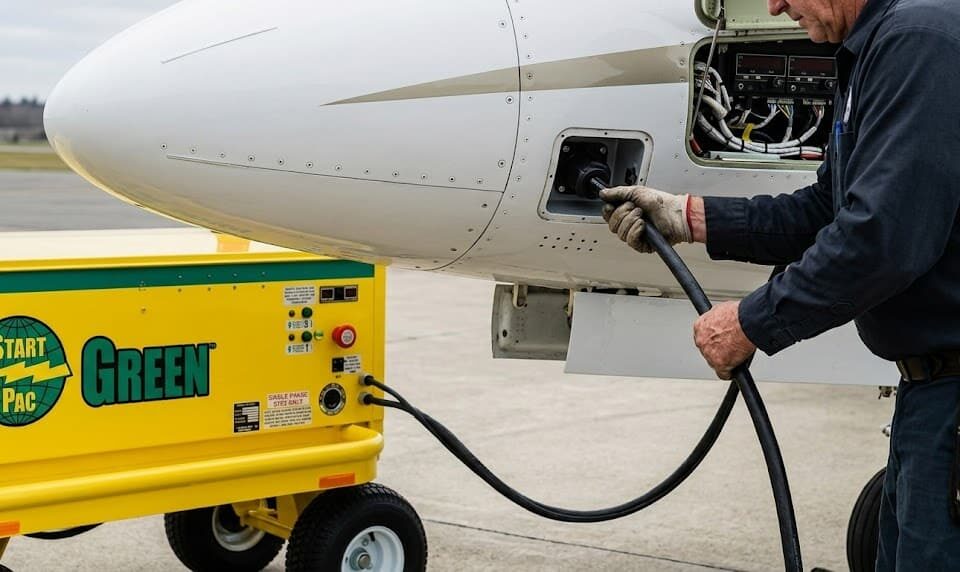
Most turbine helicopters in the Bell commercial fleet operate on 28VDC as their primary external power standard. The specification is only part of the picture. What matters is that power delivered during ground operations remains clean, regulated, and within tolerance throughout the entire service sequence without interruption.
Bell helicopter maintenance procedures specify connection and disconnection sequences for a reason. Connecting external power while cockpit switches are in the wrong configuration, or disconnecting before systems have properly de-energized, generates fault codes and avionics resets that show up in maintenance write-ups. They create downstream work. That work takes time neither the aircraft nor the operator has.
For helicopter avionics power on glass-panel platforms, the draw occurs across multiple buses simultaneously during initialization. A ground power unit that can’t hold steady output voltage through that startup sequence will produce anomalies that are time-consuming to diagnose and easy to misattribute. Voltage sag mid-initialization is one of the more consistent sources of unexplained avionics faults in turbine helicopter servicing environments.
Voltage regulation performance under load matters more than peak output rating. A higher amp-hour figure does not compensate for a unit that sags when the avionics bus comes online. This is where mechanics should be looking, not at the rated capacity, but at the regulated output under real operating conditions.
Selecting the Right Ground Power Unit for Bell Platforms
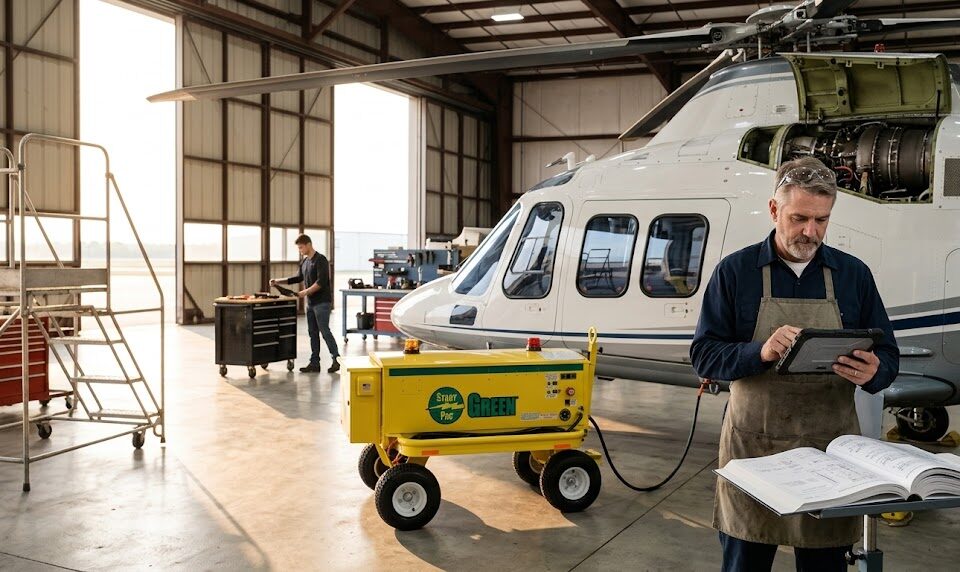
The right helicopter ground power unit for Bell platforms depends on where and how the aircraft is being serviced.
Key GPU Specifications Mechanics Should Look For
Selection starts with the aircraft, not the unit.
Most Bell turbines operate on 28VDC, but requirements vary by platform. Mechanics should confirm:
- correct voltage output
- sufficient current capacity under full avionics load
- stable, regulated output during system initialization
On glass-cockpit aircraft, voltage stability under load matters more than peak rating. A unit that sags during startup will introduce faults regardless of its advertised capacity.
Portable Units vs. Cart-Based Solutions
The operating environment determines the form factor.
- Cart-based GPUs: suited for FBOs and MROs with fixed infrastructure and high daily usage.
- Portable GPUs: essential for remote sites, offshore operations, and field maintenance.
If the unit cannot be positioned where the aircraft is serviced, it is not operationally viable.
Military vs. Civilian Operational Requirements for GPUs
While specifications may overlap, operational demands do not.
- Civilian environments prioritize consistency and efficiency. GPUs are used frequently, maintained regularly, and expected to deliver stable output across repeated service cycles. Downtime affects schedules and revenue.
- Military and forward operations prioritize reliability under stress. GPUs must perform in austere conditions, tolerate irregular use, and deliver full output without warning after storage. Power instability during avionics startup can delay mission readiness, not just maintenance.
Battery behavior is a key divider. Civilian units benefit from frequent cycling, while military units must hold charge reliably and perform immediately after idle periods.
What to Avoid: Undersized or Aging Equipment
A GPU can connect and still be wrong. Undersized or degraded units often:
- voltage-sag under load
- trigger avionics faults during initialization
- create unnecessary troubleshooting cycles
Using a unit sized for a lighter aircraft on a larger Bell platform is a common mistake. Connection does not equal compatibility; power quality is the real requirement.
START PAC® Solutions for Bell Operators & Mechanics
START PAC has supported helicopter operations since its founding in 1997. The product line includes portable starting units, ground power units, and power supplies engineered for the voltage regulation demands of turbine helicopter servicing across commercial, military, and specialty applications.
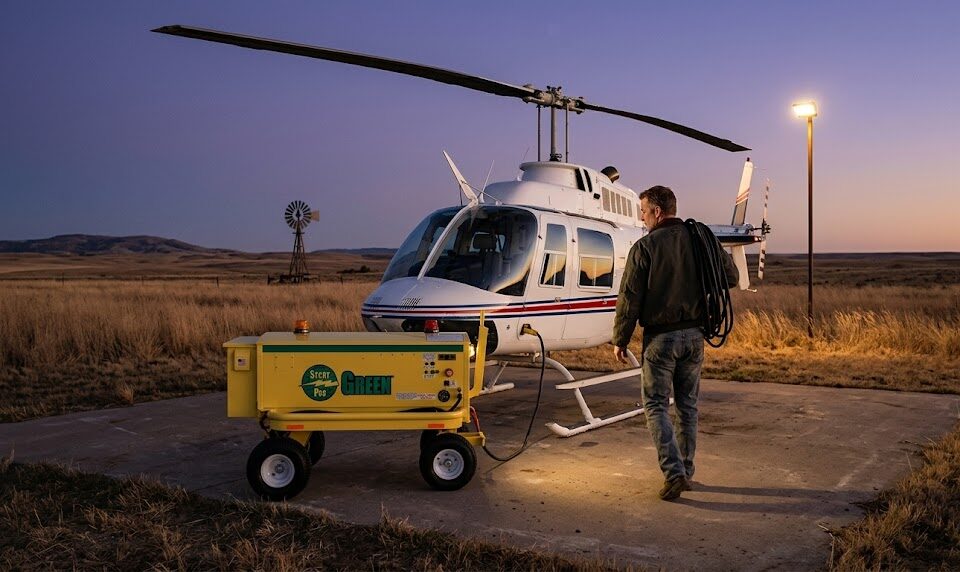
One contract pilot documented arriving at a remote Texas airstrip after dark with a dead battery on board. The START PAC unit made the difference between a stranded aircraft and a flight home that night. That is the operational standard this equipment is built to.
For Bell fleet operators, START PAC offers helicopter-specific GPU and starting unit configurations in 24V and 28V. The patented Quick Change™ battery replacement system allows depleted batteries to be swapped in minutes without tools, a meaningful advantage in high-cycle maintenance environments where turnaround time is never negotiable.
All START PAC products are ISO 9001:2015 certified and manufactured at the Las Vegas facility. The pre-sales team provides aircraft-model-level guidance. When a mechanic needs to confirm GPU compatibility with a specific Bell platform before purchase, that conversation starts with a direct call, not a spec sheet interpretation and a guess.
For operators managing mixed Bell fleets, standardizing on a single GPU solution across 407s, 412s, or any combination reduces training variability and simplifies troubleshooting when a ground support issue does arise. One known-good power source across a fleet is a more defensible maintenance standard than a collection of untested alternatives from different manufacturers.
Final Thoughts
Ground power for Bell helicopter maintenance is part of the maintenance process. Not an afterthought. When it is handled correctly, it is invisible. When it is not, it generates write-ups, fault codes, and diagnostic hours that should not exist.
The Bell fleet spans enough platform variety that mechanics and ground crews need to understand what each aircraft actually requires before connecting a GPU. Different models carry different avionics sensitivities. Military platforms add operational constraints that change the equipment calculus entirely. The right ground power unit, connected in the correct sequence, keeps aircraft serviceable and keeps maintenance logs clean.
Contact the START PAC® team directly for platform-specific recommendations, or explore the full GPU and starting unit product range at startpac.com.