


Every week, somewhere in a hangar, an avionics technician begins a G1000 NXi database update on aircraft battery power and finishes it with a corrupted file, an incomplete install, or a system fault they cannot immediately explain. Battery voltage was reading normal. Nothing alarming happened. Until it did.
This is the mistake that costs operators hundreds to thousands of dollars per incident, and it is entirely preventable.
Garmin G1000 ground power requirements are more specific than most technicians expect. This reference covers what the system needs during programming and database updates, what goes wrong when those requirements are not met, and how to select the right ground power solution: practical information for avionics technicians, A&P mechanics, FBOs, and flight schools managing aircraft equipped with the G1000 NXi.
What Is the Garmin G1000 NXi and Why Does It Matter
The G1000 NXi is Garmin’s second-generation integrated glass cockpit suite, now standard across a significant portion of the general aviation training fleet. Understanding what this system requires during ground operations is the foundation for any discussion of how to power it safely.
How Widely Is It Used Across General Aviation and Training Fleets
The G1000 NXi is standard in many of the most common training aircraft of the past decade:
- Cessna 172 Skyhawk
- Piper PA-44 Seminole
- Beechcraft Bonanza G36
A single FBO or flight school may have 10, 15, or 20 aircraft requiring periodic database updates. Each is an opportunity for an under-powered programming session to introduce a failure condition.
Why Its Complexity Makes It Sensitive During Programming and Database Updates
The G1000 NXi is not a standalone avionics box. It is an integrated system of multiple line-replaceable units (LRUs) communicating over a shared data bus. A database update may simultaneously write to navigation, terrain, and obstacle databases across several connected units. That process requires consistent, uninterrupted power: not approximately the right voltage, but stable voltage held throughout the entire session.
The Stakes: What Happens When a Programming Session Goes Wrong
A failed programming session can ground an aircraft. Some failures surface immediately; others appear only on the next flight. In a fleet environment, a single corrupted update can ground a training aircraft for days. That is lost revenue, disrupted student scheduling, and a direct hit to retention.

Understanding the G1000 NXi System Architecture
The G1000 NXi integrates multiple discrete avionics components into one interconnected flight deck, all sharing the aircraft electrical systems that power them on the ground. Power stability is a hard requirement, not a recommendation.
How System Components Work Together During Power-Sensitive Operations
Every G1000 NXi component communicates continuously over a shared data bus during a programming session. The system includes the PFD, MFD, GIA units, GSU 75 ADAHRS, engine and airframe monitoring units, transponder, and autopilot components in many configurations. Power demand stays elevated throughout, and a voltage sag at any point is felt system-wide.
G1000 Diagram: A Look at System Integration
A G1000 diagram shows a hub-and-spoke architecture with the GIA units at the center, connecting the PFD, MFD, GSU 75 ADAHRS, engine monitoring unit, transponder, and navigation sources. There is no isolated subsystem. A power interruption at the bus level affects the entire integrated flight deck.
Why a Stable Power Source Is Non-Negotiable During Avionics Configuration
During configuration and software events, the GIA units write to internal memory. A brief interruption can leave memory in a state the system cannot self-repair, requiring a full reflash or avionics shop intervention. Stable power during avionics configuration is the minimum standard, not a cautious upgrade.
What Is the Garmin GSU 75 and Why Power Stability Matters
The GSU 75 is Garmin’s Air Data, Attitude, and Heading Reference System for the NXi platform, consolidating airspeed, altitude, vertical speed, attitude, and heading functions into a single unit that feeds data continuously to the integrated system.
The Role of the GSU 75 Within the G1000 NXi System
The GSU 75 interfaces directly with the GIA units over the G1000 data bus, feeding airspeed, altitude, vertical speed, attitude, and heading data continuously. During a software event, configuration changes must synchronize between the GSU 75 and the GIA in real time. A power sag mid-synchronization can leave both units in mismatched states that do not resolve on reboot, resulting in an avoidable shop visit.
How the GSU 75 Interfaces With Other Components During Programming
Configuration changes written to the GSU 75 must synchronize with corresponding GIA data simultaneously, not sequentially. If power sags mid-synchronization, the two units may end up in mismatched configuration states that don’t resolve on the next boot and require manual shop reconfiguration.
General Power Sensitivity Considerations During GSU 75 Operations
Most aircraft batteries deliver acceptable voltage at power-up but not through 30 to 60 minutes of sustained avionics load. External power is not a precaution for GSU 75 operations. It is the only way to guarantee the voltage stability this component requires throughout a complete programming session.
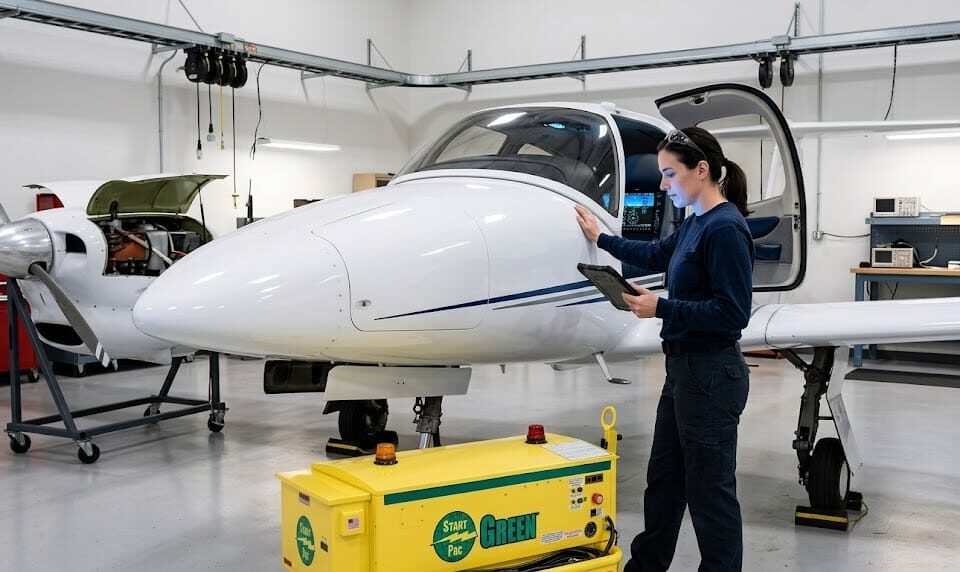
Garmin G1000 Ground Power Requirements: What You Need to Know
Meeting Garmin G1000 ground power requirements is not about finding a ground power unit strong enough to start the aircraft. It is about finding a power source that behaves the way aircraft electrical systems behave at engine-running voltage: stable, clean, and consistent throughout the session.
Why Aircraft Battery Power Alone Is Insufficient During Extended Programming
An aircraft battery under sustained avionics load does not hold voltage. A battery that measures 28V at rest may deliver 27.2V after 20 minutes of loading and lower still after 40. For most aircraft systems, that drift is manageable. For an avionics system writing to internal memory across multiple LRUs simultaneously, it is not. Drift below the G1000 NXi’s operating band mid-session, and the system does not compensate gracefully.
What Regulated, Stable External Power Looks Like for Avionics Work
A regulated external power supply for avionics work holds output voltage at or near aircraft-running voltage, typically 28V for most G1000 NXi installations, without fluctuation regardless of load variation.
Regulated output is the key phrase. Plenty of ground power equipment delivers adequate amperage. Not all of it delivers regulated voltage. For avionics programming, that distinction is the entire difference.
The Difference Between Adequate Power and the Right Power
Adequate power gets the avionics system to boot. The right power keeps it stable for the duration of a database update or configuration event. Clean DC at regulated aircraft-running voltage, delivered consistently from session start to session end. Everything else introduces risk.
The Real Cost of Programming on Battery Power
There is a specific cost to every programming session run on battery power. Most operators never calculate it in advance. The failures are instructive.
What Can Go Wrong Mid-Session: Corrupted Databases, Incomplete Updates, System Faults
A voltage sag mid-session can interrupt a database write operation. The file on the SD card may be intact. The file in the unit’s internal memory may not be. The system may accept the installation, report completion, and surface a fault on the next power cycle or the next flight. Corrupted navigation databases are the most common outcome. In more serious cases, a system configuration file is affected, requiring a full reconfiguration event at the avionics shop.
Downstream Consequences: Avionics Shop Fees, Return Trips, Grounded Aircraft
An avionics shop visit triggered by a failed database installation typically starts at several hundred dollars for diagnosis and reinstall. For a flight school, a grounded aircraft during peak season affects scheduling, student progress, and retention. Those costs never appear on the maintenance invoice.
How Repeat Battery Cycling During Programming Shortens Battery Service Life
Each programming session that draws a lead-acid battery through 45 minutes of avionics load is a sustained discharge cycle, and sustained discharge cycles age batteries. Operators who run database updates on battery power regularly are accelerating degradation on a schedule they rarely track. Aircraft batteries are not inexpensive, and the cumulative cost across a fleet tends to stay invisible until replacements start coming earlier than expected.
The Math: What One Failed Programming Session Actually Costs an Operator
Avionics shop labor runs $150–$250 per hour, with a reinstall and verification typically requiring 2–3 hours minimum. Add one to three days of aircraft downtime. A conservative estimate for a single failed session lands between $500 and $900. A proper ground power supply is a one-time investment. The math is not close.
Best Practices for G1000 NXi Programming & Database Updates
Sound procedure during aircraft maintenance involving avionics programming is not complicated. It is consistent: the same steps, every session, regardless of how familiar the equipment feels.
Always Use External Ground Power During Any Programming or Update Session
External ground power for every avionics session is the only policy that eliminates the variable. No exceptions for short sessions, familiar equipment, or recently charged batteries. A 10-minute software configuration event carries the same voltage-sensitivity risk as a 60-minute database update. The threshold for acceptable battery behavior during avionics programming is not time-based. It is load-based.
Ensuring GPU Output Is Clean and Regulated, Not Just Powerful Enough
Verify that the ground power unit in use is rated for avionics work, not just for aircraft starting. Starting units deliver high-current output for short bursts. That is a fundamentally different design priority than regulated voltage stability under sustained load. Check the unit’s regulated voltage specification before use. The capability to start an engine does not confer the capability to safely power an avionics programming session.
Proper Connection and Sequencing Before Initiating Any Avionics Update
Connect the external power unit before powering on the avionics system. Confirm stable voltage at the aircraft connector before initiating the G1000 NXi boot sequence. Connect first, verify output, then power the system. A connection event that introduces a surge or interruption at initialization is not a neutral event.
Monitoring Power Throughout the Session: What to Watch For
If the GPU has a voltage display, monitor it throughout the session. A regulated supply should not fluctuate meaningfully under normal avionics load. Variation exceeding 0.5V is a signal to pause before any write operation completes. A power source that starts cleanly is not guaranteed to finish cleanly.

Choosing the Right Ground Power Unit for Avionics-Sensitive Work
The ground power equipment market offers a wide range of products, but for avionics-sensitive work (programming, configuration, and extended maintenance), the selection criteria narrow considerably.
What to Look for in a GPU Designed for Avionics Programming Environments
Regulated DC output at aircraft-running voltage is the primary specification. For most G1000 NXi aircraft on 28V systems, this means stable, regulated 28V DC under sustained load, not a unit that starts at 28V and drifts as demand continues. Current capacity must also cover a fully active avionics suite, not minimum system load, with enough headroom to hold regulated output through a complete session.
Portable vs. Cart-Based Solutions for FBOs, Flight Schools, and Avionics Shops
FBOs and flight schools managing multiple aircraft benefit from portable units that move between aircraft without fixed infrastructure. Avionics shops with dedicated work bays may prefer fixed or semi-fixed configurations. The right form factor depends on how the equipment is deployed in practice, not just what it outputs.
Why Power Quality Matters More Than Raw Amperage
High amperage is not the same as clean power. Starting units are engineered for peak current delivery, not regulated voltage stability under sustained load. For avionics programming, regulated DC voltage held stable throughout the session is the specification that matters. More amps from an unregulated source does not solve a voltage stability problem.
What to Avoid: Aging Equipment, Unregulated Sources, Undersized Units
Aging equipment may no longer deliver the regulated output its nameplate specifies. Unregulated sources, including older GPU designs and non-aviation equipment adapted for ramp use, do not hold voltage under varying loads by design. Undersized units will sag under real G1000 NXi operating conditions. Equipment selection requires current verified specifications, not assumptions based on past performance.
START PAC® Solutions for G1000 NXi Operators and Avionics Shops
START PAC®, founded in 1997 by pilot and engineer Jim Wurth and manufactured in Las Vegas, Nevada, builds ground support power equipment engineered for professional aviation operations where output quality and voltage regulation matter.
How START PAC® Units Deliver Clean, Regulated Power for Avionics Programming
START PAC® power supplies simulate aircraft-running voltage on the ground without the engine running, delivering the stable, regulated output avionics systems require during testing, maintenance, and programming. Unlike starting units optimized for high-current burst output, they maintain consistent voltage under sustained avionics load. For a G1000 NXi programming session, that distinction is the point.
Recommended Products for Avionics-Sensitive Ground Support
START PAC® offers 28V power supplies suited to the configuration most G1000 NXi installations use. The 53025 is the portable option for avionics shops and FBOs where space and mobility matter.
For operations requiring both starting capability and sustained avionics-grade power, combination ground power units provide both in a single portable unit. Verify model specifications against your aircraft’s electrical requirements, and contact START PAC® directly for aircraft-model-level guidance across general aviation, military, and commercial platforms.
Support Resources and Where to Learn More
Full product specifications, application pages, and direct contact options are available at startpac.com. For avionics shops, FBOs, and flight schools evaluating ground power solutions for G1000 NXi operations, START PAC® can recommend the right unit based on aircraft type, system voltage, and operational profile.
Conclusion
Programming a Garmin G1000 NXi on aircraft battery power is a risk that surfaces as a cost, sometimes immediately, sometimes several flights later. The failure modes are documented. External ground power that meets the system’s voltage and regulation requirements eliminates the variable entirely.
The right ground power solution is among the least expensive forms of protection available to any avionics technician, FBO, or flight school managing G1000 NXi aircraft.
Browse START PAC®’s ground power solutions built for avionics-sensitive operations at startpac.com, or contact the team directly for guidance on the right unit for your aircraft and operational requirements.