

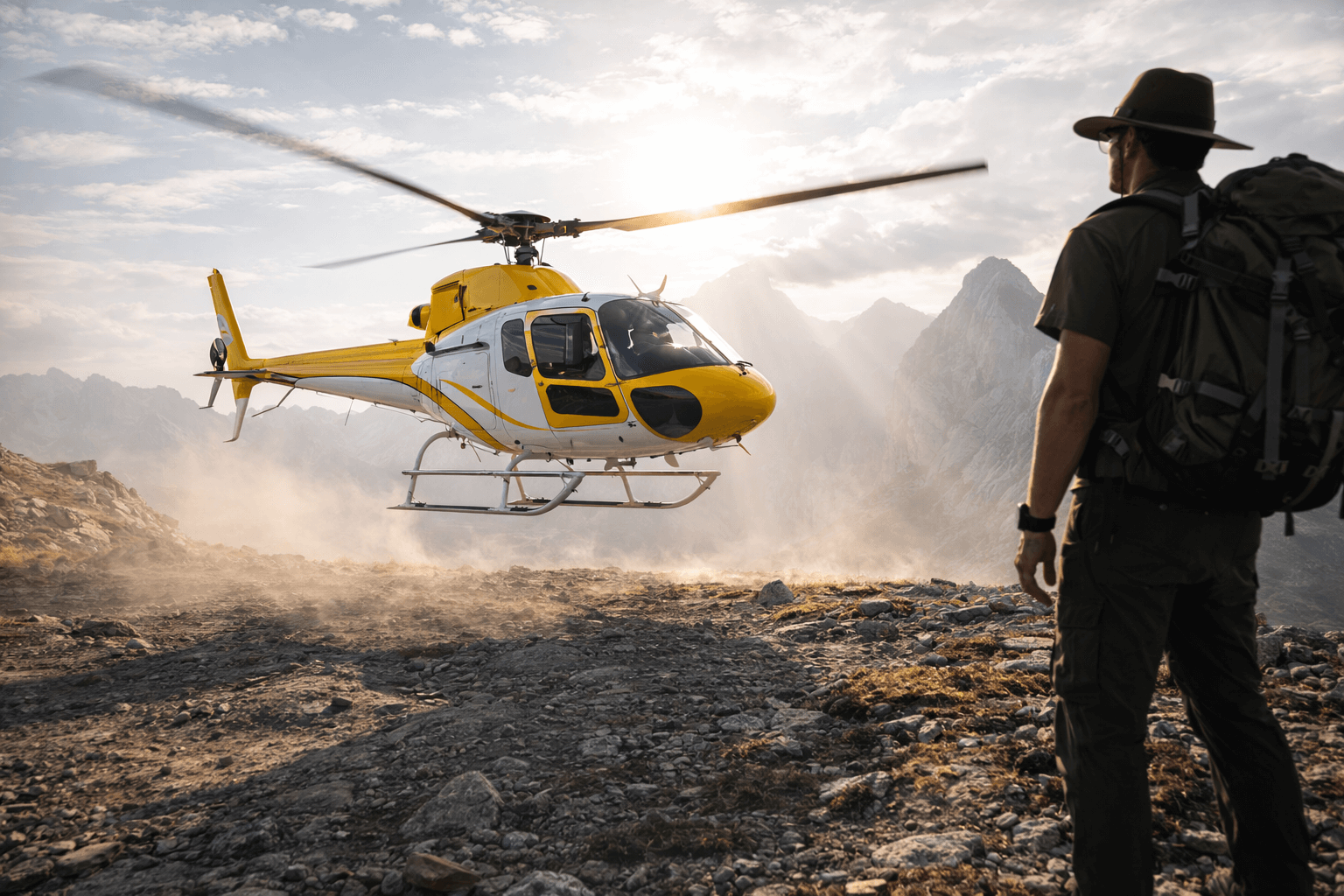
While airplanes excel at speed and efficiency, they share a fundamental limitation: all of them need a runway. Helicopters exist precisely because this constraint creates problems that fixed-wing aircraft cannot solve. A rotor-driven machine can hover motionless over a single point, fly backward, and touch down on a patch of ground barely larger than a tennis court.
These abilities make helicopters the tool of choice when access matters more than speed. When a flood traps survivors on a rooftop or a remote mountain station needs a new generator, nothing else can do the job. The pilot must constantly balance lift, thrust, and drag in an ongoing negotiation with gravity.
Of course, not every rotorcraft is built the same way or intended for the same purpose. The industry produces an enormous variety of helicopter types to meet different demands. A compact two-seat trainer bears almost no resemblance to a massive aerial crane.
How Helicopters Are Classified
No single system governs how helicopter types get sorted into categories. Aviation professionals typically rely on three overlapping factors: mission, design, and size. The mission focuses on the job.
A helicopter built to fire missiles at enemy armor serves a fundamentally different purpose than one configured to rush injured hikers to a trauma center. Design refers primarily to the rotor system; the standard single-rotor configuration remains the most common, but alternative rotor arrangements offer distinct advantages for lifting capacity or flight stability. Size and payload group aircraft according to weight, and a light helicopter handles very differently than a heavy-lift giant.
Because helicopter classifications overlap, most types of helicopter fit into several categories at once. A utility helicopter might serve as a corporate shuttle on Monday morning and a search-and-rescue platform by Tuesday afternoon.
Civil Helicopter Types
Civil helicopters are the machines most people actually encounter. They serve the private sector, government agencies, and emergency services, and unlike military counterparts, they prioritize fuel efficiency, noise reduction, and compliance with civilian safety regulations.
Utility Helicopters
If there’s a pickup truck of aviation, this is it. Utility helicopters aren’t optimized for any single task; they’re built to handle almost anything reasonably well. Most feature large, open cabins with sliding doors that let crews swap out cargo, passengers, or specialized equipment in minutes.
These aircraft regularly perform aerial surveys of power lines and pipelines, carry camera crews for traffic coverage, spray crops across remote terrain, and provide air support for police operations.
The Airbus H125 has earned its reputation through exactly this kind of versatility, with an engine that maintains full power above 20,000 feet where thinner air grounds less capable machines. The H125’s maximum flight altitude reaches 23,000 feet, making it one of the highest-flying helicopters regardless of class.
Passenger and Transport Helicopters
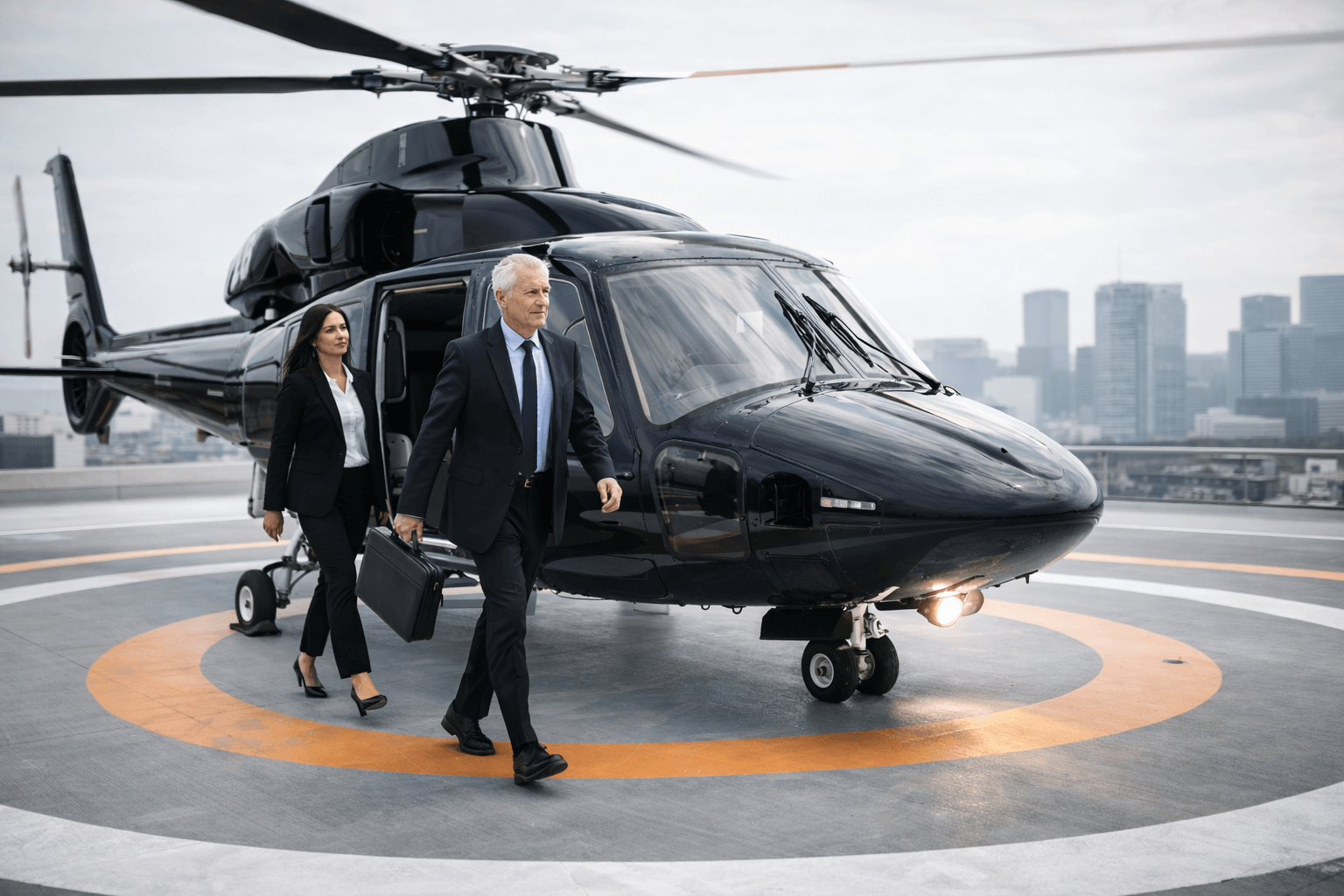
Passenger and executive transport serves a different market segment. Executive helicopters are designed to feel like luxury vehicles inside, with extensive soundproofing and seating configurations tailored to business travelers.
Transport helicopters keep offshore oil platforms supplied with workers. The rigs sit hundreds of miles from shore, so crews fly out on large twin-engine aircraft.
Offshore passenger operations typically require twin-engine helicopters because aviation regulations mandate specific performance standards for flights over water, particularly for commercial operations carrying passengers to oil platforms. These helicopter operations run daily and leave no margin for mechanical surprises.
Emergency Medical Helicopters
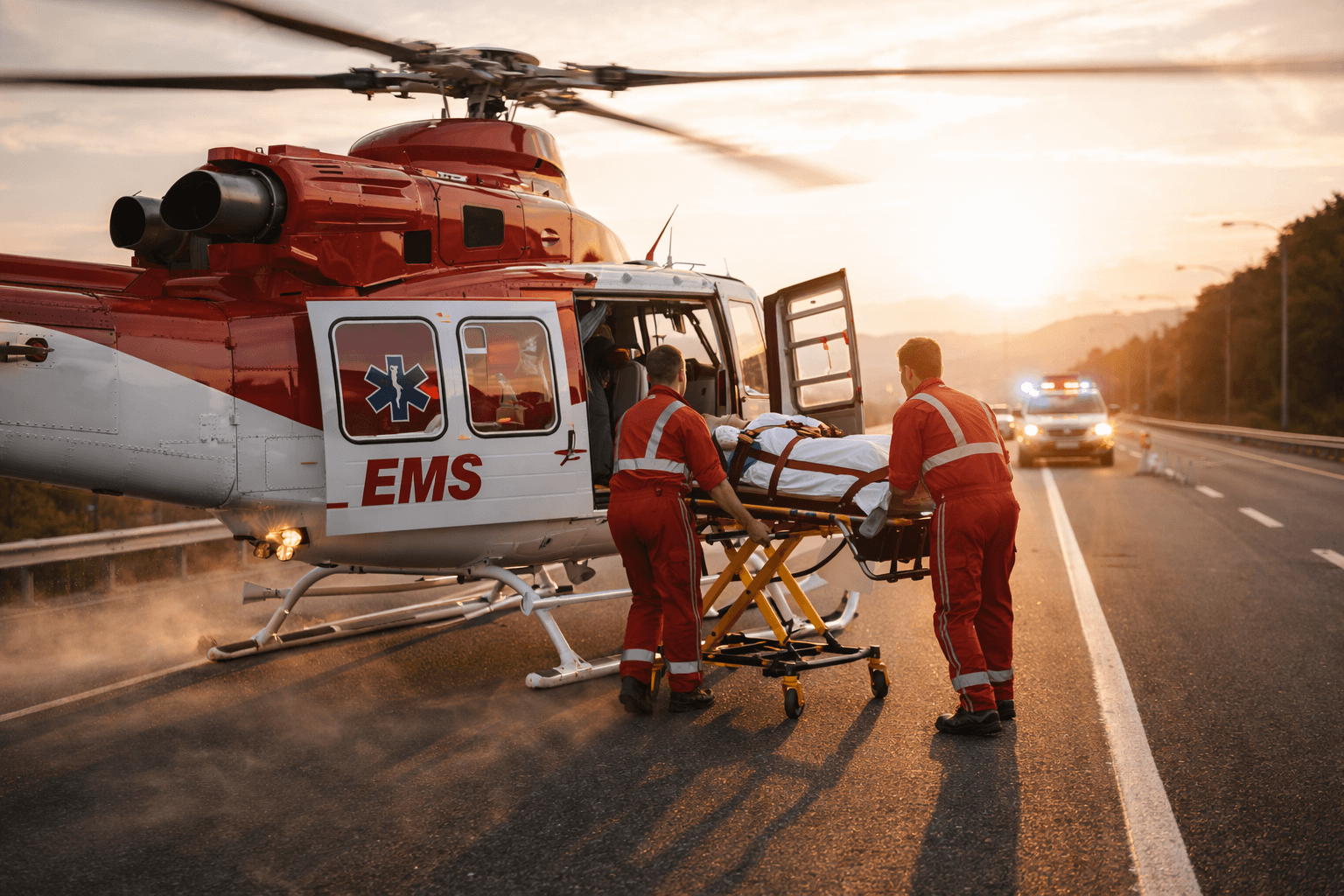
Emergency services represent another critical civil role. In a medical crisis, every minute counts. Air ambulances convert flight time into treatment time by functioning as airborne emergency rooms, modified to carry stretchers, oxygen systems, and patient monitoring equipment. Landing on a highway shoulder or an open field means reaching accident victims almost immediately.
Search and Rescue Helicopters
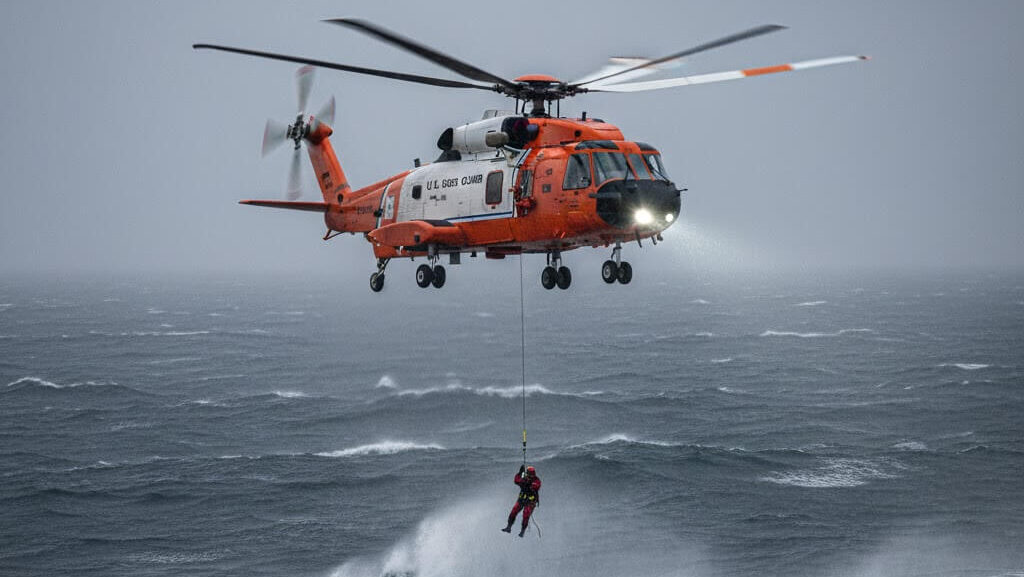
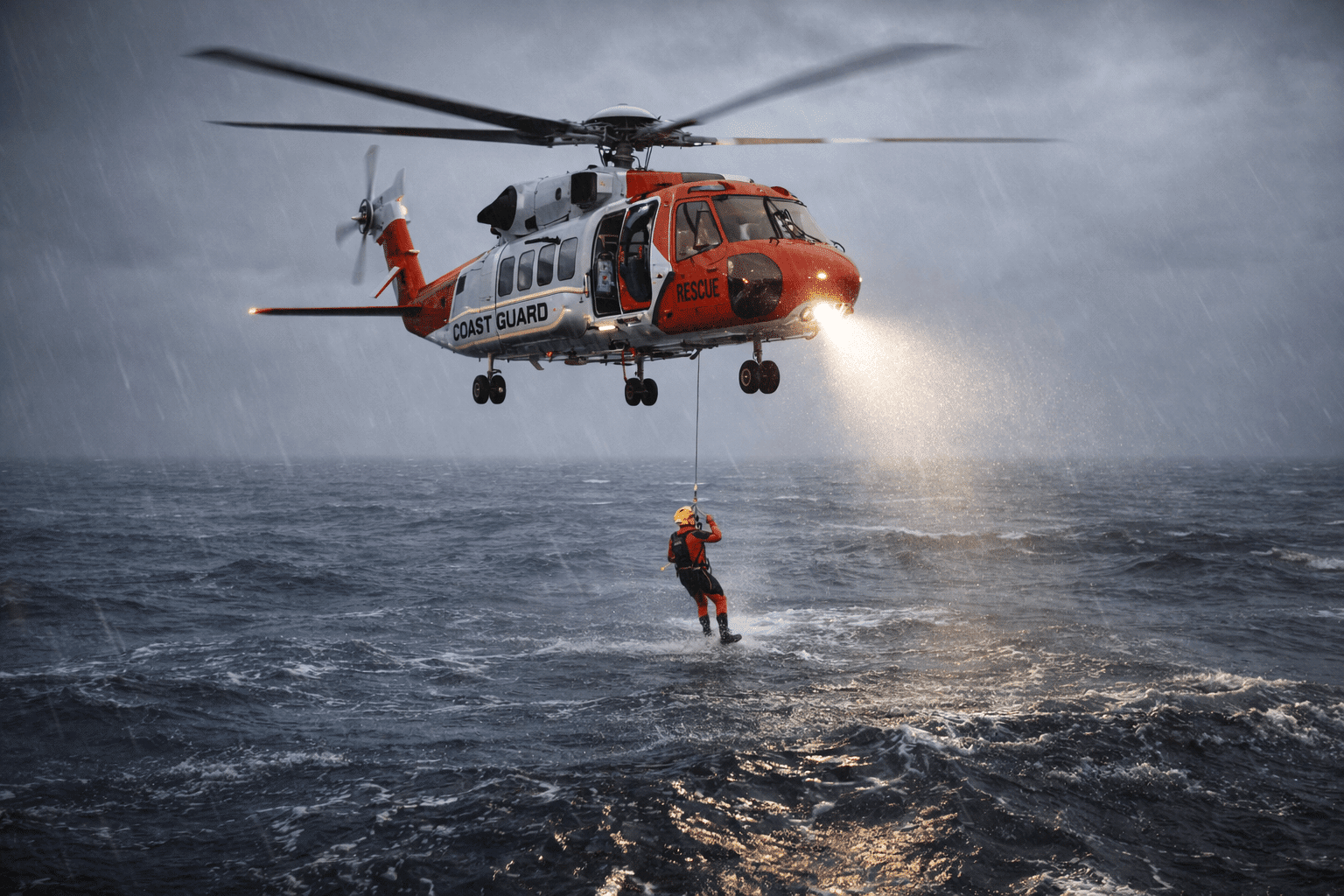
Similarly critical, search and rescue work demands serious capability. SAR helicopters must fly into storms, maintain a hover over rough seas, and pull survivors aboard using a hoist. Standard configurations for this mission include:
- Rescue hoists rated for 600-pound loads, enabling extraction of multiple survivors without landing
- Forward-looking infrared cameras that detect body heat through fog, smoke, and dense tree cover
- Auxiliary fuel bladders that extend mission endurance beyond 6 hours. The U.S. Coast Guard’s MH-60T Jayhawk demonstrates this capability, flying comfortably at 125 knots for 6–7 hours with up to 6,300 pounds of fuel.
- Airframes stressed to handle the turbulence encountered during storm penetration
The Sikorsky S-92 dominates this mission set due to its hover stability. Where other aircraft would drift in strong gusts, the S-92 holds position while crews work the hoist, and that precision determines whether a rescue succeeds.
Military Helicopter Types
While civil helicopters serve rescue and transport roles, military variants face an entirely different challenge. Military helicopters are engineered for survival in hostile environments where people may be actively trying to destroy them. This reality makes them heavier, faster, and considerably more complex than civilian aircraft, with redundant systems throughout.
Attack Helicopters
An attack helicopter is fundamentally a weapons platform designed to locate and destroy targets. These military helicopter types typically feature narrow fuselages that present smaller profiles to ground fire, and they carry combinations of machine guns, rockets, and guided missiles.
Crew members usually sit in tandem (one behind the other rather than side by side), because this arrangement improves situational awareness for both pilot and gunner. The AH-64 Apache remains the most recognized example, famous for hunting tanks in total darkness using sophisticated sensor arrays.
Transport and Cargo Helicopters
Armies move troops and cargo by air too. The UH-60 Black Hawk carries a full infantry squad and drops them where they’re needed. The CH-47 Chinook, among the heaviest army helicopter types in service, slings artillery and vehicles beneath its tandem rotors. Both aircraft are built to take hits. Fuel tanks seal when punctured, and armor shields the engines from rifle fire.
Reconnaissance Helicopters
Scout helicopters occupy a different tactical niche. Smaller and quieter than attack helicopters, they push forward toward enemy lines, gather targeting data, and relay intelligence back to command.
Modern reconnaissance platforms often mount their primary sensors on masts above the rotor disc, allowing the helicopter to hide behind terrain while keeping only the camera exposed.
Helicopter Types by Rotor Design
Rotor configuration represents another fundamental way to categorize these aircraft. How a helicopter manages torque shapes everything else about its design, and different rotorcraft types solve this engineering problem through different approaches.
Single-Rotor Helicopters
Most helicopters flying today use this arrangement. A large main rotor generates lift, and the engine’s torque would spin the fuselage in the opposite direction if left unchecked. A smaller tail rotor mounted at the rear pushes against this tendency and keeps the nose pointed forward.
The arrangement works well, but the tail rotor represents a vulnerability. Striking an obstacle means losing directional control entirely. Loss of tail rotor effectiveness has been cited as a contributing factor in dozens of NTSB investigations, though these incidents typically involve complex interactions between design characteristics, flight conditions, and pilot actions rather than mechanical failures alone. This complexity explains why tail rotor dynamics are central to understanding the cause of a helicopter crash.
Tandem-Rotor Helicopters
In contrast, tandem designs position two large main rotors along the fuselage, spinning in opposite directions. Because the counter-rotation cancels torque naturally, no tail rotor is needed. All available engine power goes toward generating lift, the aircraft handles uneven loads more gracefully, and hover stability is exceptional.
Coaxial-Rotor Helicopters
A third option, coaxial helicopters stack two rotors on the same central mast, again spinning in opposite directions. The arrangement delivers superior hover precision and directs all engine power toward lift instead of bleeding it off to a tail rotor. Navies favor this design because the absence of a long tail boom makes the aircraft compact enough to fit on small ship decks.
Helicopter Types by Size and Capability
Size also determines mission suitability. Industry professionals generally group helicopters into weight categories, though exact thresholds vary by region and regulatory body:
- Light helicopters include popular trainers like the Robinson R-22 and Bell 206. A single engine keeps them fast and agile, though cargo space and range remain limited. Training programs, police departments, and private owners account for most of the demand.
- Intermediate helicopters include workhorses like the AS350 and Bell 407. This class balances agility with useful payload capacity.
- Medium helicopters carry twin engines that provide the redundancy required for air ambulance work and offshore transport. Examples include the Bell 212/412 and Sikorsky S-76.
- Heavy helicopters feature massive engines and enormous rotor discs that give them the strength to move troops in quantity and transport vehicles. Examples include the Sikorsky S-61 and Boeing CH-47 Chinook.
The practical differences between helicopter types extend well beyond size.
How Helicopter Capabilities Differ
The gaps between helicopter models can be substantial:
- Payload capacity varies dramatically with conditions. Hot, thin air at mountain landing zones reduces rotor efficiency, so an aircraft’s actual lifting ability may fall well short of its rated maximum.
- Speed and endurance lag behind fixed-wing aircraft. Cruise speeds are generally less than 160 knots, and without auxiliary tanks, most helicopters run out of fuel within 250–500 miles.
- Cockpit systems have changed dramatically over the past two decades. Pilots now monitor digital terrain maps instead of paper charts, fly through zero visibility using sensor feeds, and hand off hover duties to autopilot systems.
- Operating environments vary widely. Urban missions demand low-noise rotors; maritime aircraft need corrosion-resistant airframes and emergency flotation systems; high-altitude work requires engines optimized for thin air.
- Ground support requires external power sources for engine starts. Portable helicopter ground power units spin up turbines without pulling from onboard batteries, so aircraft stay ready for immediate tasking.
None of these factors exist in isolation, which is why selection rarely comes down to a single variable.
FAQ
What are the main helicopter types?
The primary categories include civil helicopters (utility, transport, EMS, and SAR) and military helicopters (attack, transport, and reconnaissance). They’re also classified by rotor configuration: single-rotor, tandem, or coaxial.
What is the difference between military and civil helicopters?
Military helicopters incorporate armor, weapons systems, and encrypted communications for combat environments. Civil helicopters prioritize efficiency and passenger comfort while meeting civilian airspace regulations.
What type of helicopter is used by the army?
Armies deploy mixed fleets: the Apache handles attack missions, the Black Hawk moves troops, and the Chinook provides heavy lift capability.
Which helicopter type can lift the most weight?
The Mi-26 and CH-53K King Stallion lead the field. The Mi-26 can carry payloads up to 20 tonnes (44,000 lb), while the CH-53K has a maximum external lift capability of 36,000 lbs. Both can haul armored vehicles and shipping containers that would ground smaller aircraft.
Are some helicopters designed for multiple roles?
Many are. Utility helicopters swap configurations regularly: seats come out when cargo needs to go in, and rescue hoists bolt on when the mission changes.
Conclusion
No other aircraft can land on a rooftop, hover over a sinking ship, or deliver cargo to a peak with no runway in sight. That capability explains why helicopters exist, and why so many different helicopter types have evolved.
The engineering varies considerably across the fleet. Scout helicopters stay small and quiet; heavy-lift transports sacrifice agility for raw power. Rotor configurations, weight classes, and helicopter roles all shape what a given aircraft can accomplish. Selecting the right helicopter means understanding these tradeoffs and matching the machine to the task.