


In-flight Wi-Fi used to be a compromise: slow, expensive, and unreliable above 30,000 feet. That is changing fast. Starlink Aviation, SpaceX’s low-Earth-orbit (LEO) satellite internet service for aircraft, is resetting expectations for connectivity across commercial, business, and general aviation (GA). For maintenance, repair, and overhaul (MRO) teams, fixed-base operators (FBOs), and fleet managers, this shift is not just about passenger Wi-Fi. It is a new category of avionics integration with direct implications for aircraft electrical systems and ground support planning.

What Is Starlink Aviation
Starlink Aviation uses SpaceX’s LEO satellite constellation to deliver broadband-speed internet to aircraft in flight, replacing older geostationary orbit (GEO) systems that suffer from higher latency and inconsistent coverage. Unlike consumer Starlink terminals, the aviation product requires a Supplemental Type Certificate (STC), an approval issued by the Federal Aviation Administration (FAA) or the European Union Aviation Safety Agency (EASA) confirming the hardware is safely integrated with a specific aircraft type before it can be installed.
How It Differs From Legacy Systems
Older in-flight connectivity (IFC) systems relied on GEO satellites positioned roughly 22,000 miles above the equator, which introduces noticeable lag and bandwidth limits. LEO constellations orbit at a fraction of that distance, cutting latency enough to support real-time applications like video calls and cloud-based work, not just browsing and email. That performance gap is a large part of why airlines are moving quickly to retrofit or specify Starlink on new deliveries.
Certification Requirements
Installation is not a plug-and-play add-on. Every airframe needs its own STC, and the work has to be performed by authorized integrators operating FAA Part 145 repair stations. Each certification package covers structural mounting, wiring, and verification that the terminal does not interfere with existing communication, navigation, or flight control systems.
Commercial Airline Adoption Is Accelerating
Commercial carriers have moved past pilot programs into fleet-wide commitments, and the pace has picked up noticeably over the past year.
American Airlines
American Airlines is equipping more than 500 narrowbody Airbus aircraft with Starlink, including new A321XLR and A321neo deliveries, with the retrofit program beginning in the first quarter of 2027. The carrier’s existing Airbus fleet currently runs on IFC from Viasat and SES, and American has said it will continue working with those providers alongside Starlink rather than replacing them outright.
Lufthansa Group
Lufthansa Group is equipping around 850 aircraft with high-speed Starlink connectivity, with rollout starting in the second half of 2026 and full fleet coverage targeted by 2029. The airline group has framed the move as central to its premium passenger experience strategy across all of its carriers.
United Airlines
United received FAA approval for a Starlink STC amendment covering the Boeing 737-800, building on earlier certification for its Embraer 175 regional fleet. United has been installing the system on dozens of aircraft per month, and more than half of its regional fleet is already equipped.
Across the industry, Starlink signed 11 new airline customers in the past year, with contracts now covering more than 7,000 aircraft. That scale is a clear signal satellite broadband is moving from a competitive differentiator to a baseline passenger expectation.
Business Aviation Adoption and STC Coverage
Private and business aviation is where the operational impact is often most immediate for ground support equipment (GSE) and MRO teams, since retrofit demand is arriving now rather than years out.
NetJets and Fleet-Wide Retrofits
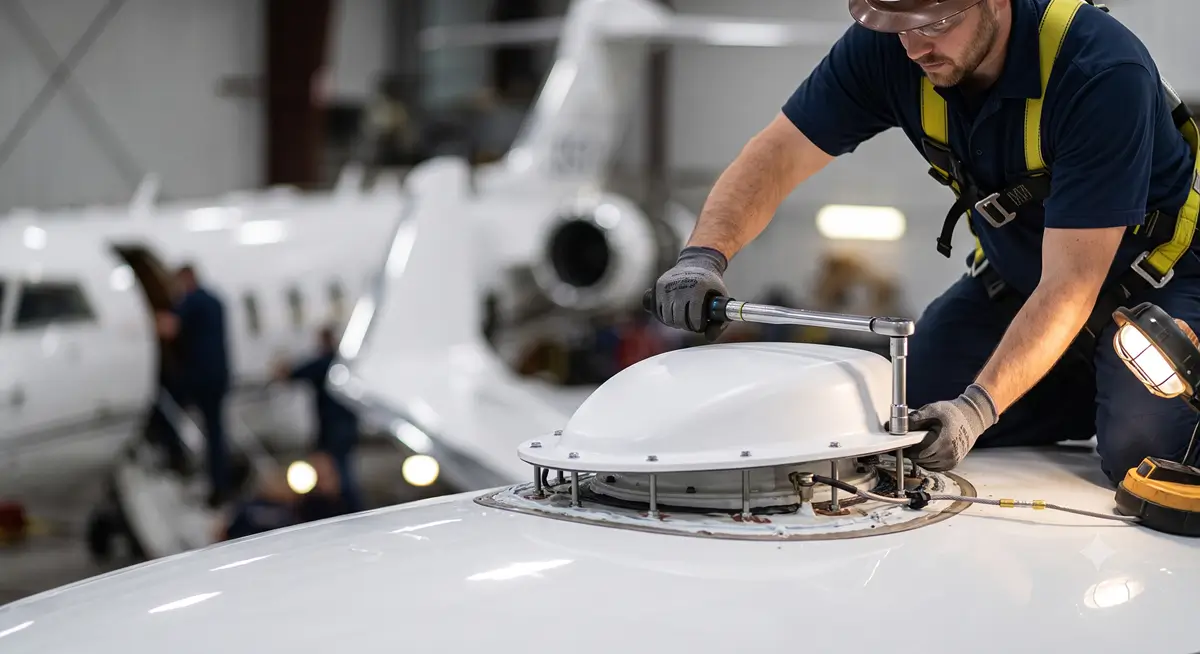
NetJets is installing Starlink high-speed Wi-Fi across roughly 600 aircraft in the United States and Europe by the end of 2026, spanning Citation Latitudes, Citation Longitudes, Praetor 500s, Challenger 350s and 650s, and its entire Global fleet. Fleet operators of this size retrofitting on a compressed timeline put real pressure on MRO shop scheduling and hangar throughput.
Expanding Aircraft-Type Certifications
STC coverage is expanding aircraft type by aircraft type. Authorized integrators list active or in-progress certifications for platforms including the King Air 200/300, the Citation Excel, XLS, Sovereign, Latitude, and Longitude, and other large-cabin business jets. FAA approval for Gulfstream G650 installations was a notable recent milestone, though Gulfstream itself flagged structural and integration considerations to operators in its own maintenance guidance following that approval. Even an FAA-approved third-party STC warrants a full review against airframe-specific service bulletins before scheduling install work.
General Aviation Faces a Different Reality
The GA experience with Starlink has been considerably rockier than the commercial and business jet story.
Pricing Changes and Speed Caps
In March 2026, Starlink enforced a 100 mph speed cap on standard Roam plans, disconnecting the consumer-grade hardware many GA pilots had been using once airspeed exceeded that threshold. To stay connected in flight, owners now need dedicated aviation tiers, starting around $250 per month for speeds up to 300 mph and $1,000 per month for up to 450 mph, with data capped near 20GB.
The Aircraft Owners and Pilots Association (AOPA) issued a formal letter to SpaceX in early March 2026 seeking a revised pricing framework, arguing the change priced out a large segment of GA pilots who had relied on more affordable plans for safety-related data.
Certification Gaps for Light Aircraft
On the installation side, STCs remain concentrated in business jets and larger turboprops. As of the most recent guidance, no STC exists for permanently mounting the full-size Starlink Aviation terminal on typical piston-single GA airframes, largely due to the terminal’s size, weight, and drag profile.
Power and Ground Support Implications for MRO Teams
This is where connectivity upgrades intersect directly with ground support planning, and it is the part of the story most relevant to hangar operations.
Electrical Load and Voltage Stability
Starlink aviation terminals draw meaningful continuous power, commonly cited in the 60 to 100W range, which has to be accounted for in the aircraft’s existing 24V or 28V electrical architecture alongside wiring, circuit protection, and weight-and-balance review. That load does not exist in isolation. It sits on top of the avionics, cabin systems, and battery charging demands ground crews already manage during maintenance, checkouts, and pre-flight prep.
Why Ground Power Equipment Matters More as Aircraft Get More Electronics Dense
This mirrors what we’ve seen with modern glass-cockpit retrofits, where Garmin G1000 ground power requirements make clear why clean, properly regulated ground power, not just any 28V source, is critical when sensitive avionics are on the bus during maintenance. Connectivity terminals raise the same question. As more electrical systems get added to an airframe, tolerance for voltage instability or dirty power during ground operations goes down, not up.
This is part of a broader trend already underway across the industry: aircraft electrical architectures are getting denser, not simpler. Our aircraft battery market overview looks at how electrification across avionics, connectivity, and starting systems is reshaping what operators need from ground power infrastructure.
For MRO shops and FBOs taking on Starlink retrofit work, ground power equipment has to deliver stable, correctly regulated voltage under load, not just enough amperage to power a screen. A ground power unit built for precision avionics work is the same piece of equipment that protects a newly installed satellite terminal during bench testing, wiring checks, and post-install verification.
Practical Considerations for Operators and Ground Crews
A few takeaways for teams planning around this shift:
- Confirm STC status before quoting retrofit work. Certification is aircraft-type specific and still expanding. Do not assume coverage exists for a given tail number without checking current integrator lists.
- Use only FAA Part 145 authorized integrators. Starlink Aviation installations require certified installers. This is not a field-modification job.
- Plan for the added electrical load. Terminal power draw needs to be factored into ground power and battery-support planning during install and maintenance, the same way avionics upgrades are.
- Expect GA demand to stay uneven until pricing and STC availability shift further. This is a business jet and commercial fleet story first.
Starlink Aviation is reshaping what “connected aircraft” means, but certification, cost, and integration requirements are still very much in motion. For ground support teams, the practical impact is not about satellites. It is about making sure the ground power infrastructure behind every retrofit, maintenance check, and pre-flight can support increasingly electronics-dense aircraft without compromise.
FAQ
Below are answers to the questions MRO teams and fleet managers ask most often when evaluating Starlink Aviation retrofits.
Does Starlink Aviation require an STC for every aircraft?
Yes. Each aircraft type needs its own Supplemental Type Certificate before installation, and coverage is still expanding rather than universal.
How much power does a Starlink Aviation terminal draw?
Continuous draw is commonly cited in the 60 to 100W range, which needs to be factored into the aircraft’s 24V or 28V electrical system alongside existing avionics and cabin loads.
Is Starlink available for general aviation aircraft?
Non-certified, speed-limited service is available through consumer plans, but full-size aviation terminal STCs currently remain concentrated in business jets and larger turboprops rather than typical piston-single GA aircraft.
Who can install Starlink Aviation systems?
Only FAA Part 145 authorized integrators can perform certified installations, working from the specific STC approved for that aircraft type.