
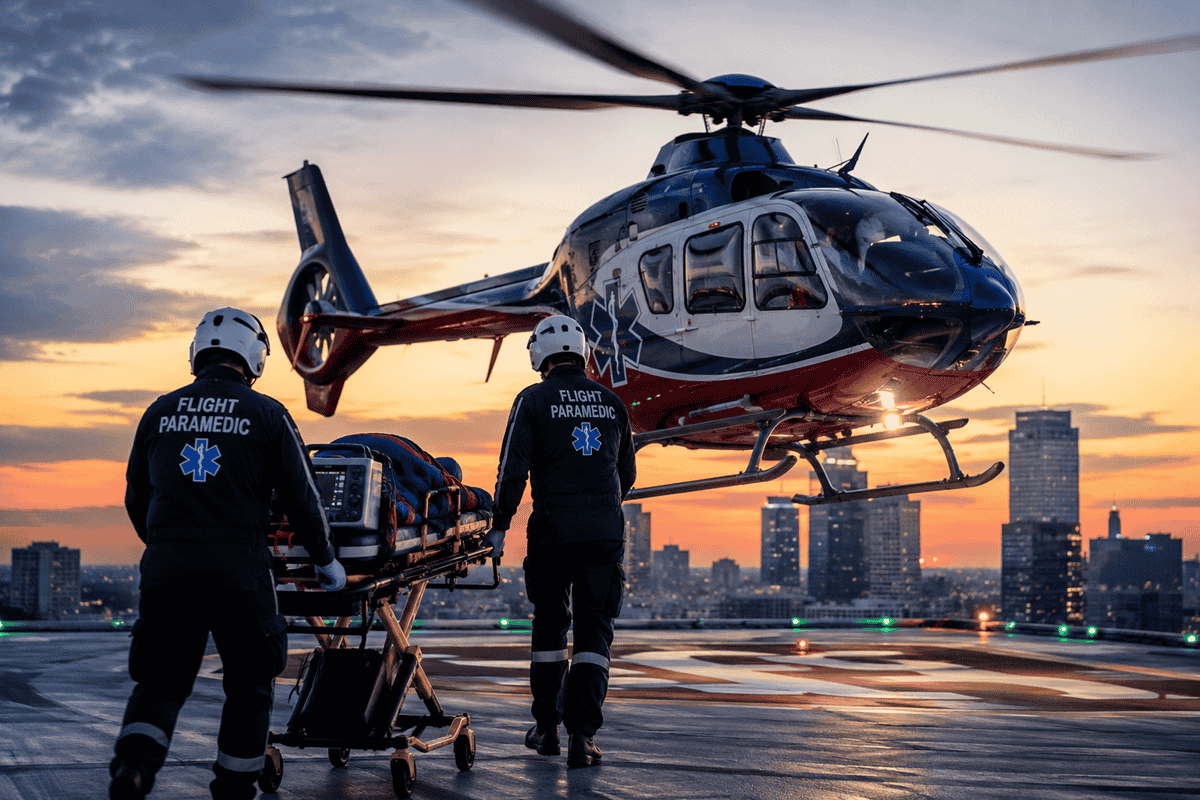
Helicopter Emergency Medical Services (HEMS) crews fly on-demand, at night, into deteriorating conditions, to locations no fixed-wing aircraft can reach. That mission profile is precisely what makes air medical aviation so valuable and precisely what makes it so dangerous. Between 2000 and 2020, 87 fatal air medical accidents in the U.S. resulted in 239 fatalities, with human factors implicated in 87.4% of those cases.
Understanding the cause patterns behind every medical helicopter crash is not an academic exercise. It is essential knowledge for operators, maintenance teams, and the manufacturers who support them. Knowing where the chain breaks is the only way to reinforce it before it does.
This analysis covers the four converging risk domains that define HEMS accident causation: weather exposure, mechanical and systems failure, human and operational factors, and the safety technologies that have materially shifted the risk equation over the past two decades.
How Dangerous Is Medical Helicopter Flight Compared to Other Aviation?
The numbers are stark. The fatal accident rate for U.S. civil helicopters was 0.71 per 100,000 flight hours in 2023, and HEMS is disproportionately represented within that figure. Commercial fixed-wing aviation’s fatal accident rate sits an order of magnitude lower, and even general aviation’s mixed safety record looks better once HEMS’s mission profile, night flying, single-pilot crews, unimproved landing zones, is factored out.
The reasons for that disproportion are structural. Single-pilot crews, Visual Flight Rules (VFR)-only certification, and the relentless pressure to launch in marginal conditions combine to create a risk concentration that other aviation segments rarely encounter. The patient waiting on the ground is not a metaphor; it is a documented cognitive pressure that shapes pilot decision-making in ways general aviation pilots never face.
Phase-of-flight data make the hazard geography concrete. 45% of air medical rotorcraft crashes occur during approach, landing, or departure, the highest-risk phases for any rotorcraft operation. National Transportation Safety Board (NTSB)-identified contributing factor clusters across HEMS accidents break down as:
- human error (77%)
- weather (30%)
- obstacle strikes (20%)
- mechanical failure (17%)
Weather as a Primary Factor in Medical Helicopter Crashes
Weather is rarely the sole cause of a medical helicopter crash. It is, however, the most consistently lethal amplifier in HEMS accident chains. When bad weather is present, fatality risk increases eight-fold once a crash occurs. It doesn’t just raise the odds of a crash; it lowers the odds that anyone walks away from it.
Inadvertent IMC: The Defining Weather Hazard
Instrument Meteorological Conditions (IMC) conditions carry a 1.5x higher crash risk in EMS rotorcraft analyses, and the mechanism is well understood. VFR-only operations become lethal when weather deteriorates en route: ceiling drop, fog, precipitation, and reduced visibility force pilots into instrument conditions without Instrument Flight Rules (IFR) certification or equipment to manage them.
The 2003 Life Flight 6 accident in Salt Lake City illustrates the pattern precisely. A night flight, fog, and a delayed pilot response to deteriorating conditions culminated in an NTSB-determined cause of continued flight into known adverse weather. The aircraft and crew were not deficient in isolation. The weather transition was survivable right up until the decision to continue was not reversed.
The “helicopter shopping” problem compounds this. When one operator declines a flight for weather, another may accept it. The NTSB has flagged this systemic pressure repeatedly: mission urgency migrates from the safest operator to whichever one says yes, concentrating risk precisely where it should not be.
Spatial Disorientation and Night Operations
Pilot spatial disorientation is a factor in 15% of fatal helicopter crashes, and night operations are the primary environment where it develops. Darkness eliminates the visual reference cues that rotorcraft pilots rely on for low-altitude maneuvering, cues that fixed-wing pilots at cruise altitude can afford to lose but that a HEMS pilot on final approach to an unimproved landing zone cannot. When a crash does occur at night, fatality risk more than triples compared to daytime accidents. Darkness doesn’t just make an accident more likely; it makes surviving one far less likely.
Dark night environments produce specific illusions: whiteout over snow, the black hole illusion over calm water and unlit terrain, and the complete loss of horizon reference that leads pilots to trust instruments they may not be current on. These are not edge cases.
NTSB analysis found that nighttime-related factors contributed to 38.9% of all fatal air medical fatalities from 2000 to 2020. That is not a coincidence; HEMS crews fly nights because that is when calls come in. The mission creates the exposure.
Wind Shear, Microbursts, and Dynamic Weather Phenomena
Wind shear and microburst encounters are documented contributing factors in NTSB rotorcraft accident records, and they share a common trait with inadvertent IMC: both can develop in the final minutes of a flight, after the pilot’s preflight weather picture was already formed.
Dynamic weather presents a different challenge: it may not appear in the data a pilot consults before launch. Automated weather observing stations report conditions at their location, which may be miles from the accident site.
The 2019 Survival Flight Bell 407 accident is instructive: satellite imagery later revealed low-level clouds not reflected in the nearest Automated Surface Observing System (ASOS) reading, meaning the pilot’s weather picture was materially incomplete before departure.
The HEMS Weather Tool has improved situational awareness for many operators, but Doppler radar coverage gaps remain. The NTSB has specifically recommended that those coverage limitations be addressed, recognizing that a tool is only as useful as the data feeding it.
Mechanical and Systems Failures in HEMS Operations
Human factors dominate HEMS accident causation, but mechanical failures account for 17% of contributing factors across accident records – and their interaction with weather and human performance errors compounds severity in ways that single-cause analysis misses.
Engine Failure and Powerplant Reliability
Engine failure accounts for 13.8% of all helicopter accidents broadly, and the HEMS context makes that statistic more dangerous than it appears. Many HEMS platforms are single-engine, which means a powerplant event at low altitude during approach or departure leaves almost no recovery margin. The math is unforgiving: low altitude plus degraded airspeed plus single engine equals limited options.
Maintenance protocols, inspection currency, and Maintenance, Repair, and Overhaul (MRO) quality are the variables operators can control. Understanding the full range of cause of helicopter crash factors, including powerplant reliability, allows MRO teams to prioritize interventions that directly reduce accident probability.
Electrical and Avionics System Failures
Avionics failures can strip a crew of critical situational awareness during a demanding low-altitude mission. Navigation and communication systems are not redundant luxuries in HEMS; they are survivability infrastructure. An aircraft that departs with a latent avionics anomaly is an aircraft carrying a hidden liability into the worst possible operating environment.
One underappreciated vulnerability is ground power quality during pre-flight systems checks. Faulty or unregulated external ground power can introduce voltage spikes and electrical interference that may not surface as detectable faults until the aircraft is airborne and the anomaly matters. Clean, regulated ground power is not a convenience; it is part of the safety chain.
The NTSB has also repeatedly urged flight data recorder installation in HEMS aircraft, which is currently not required. The absence of FDRs makes post-accident mechanical analysis significantly harder, meaning lessons that could prevent the next accident are sometimes simply not available.
Post-Crash Fire as a Fatality Multiplier
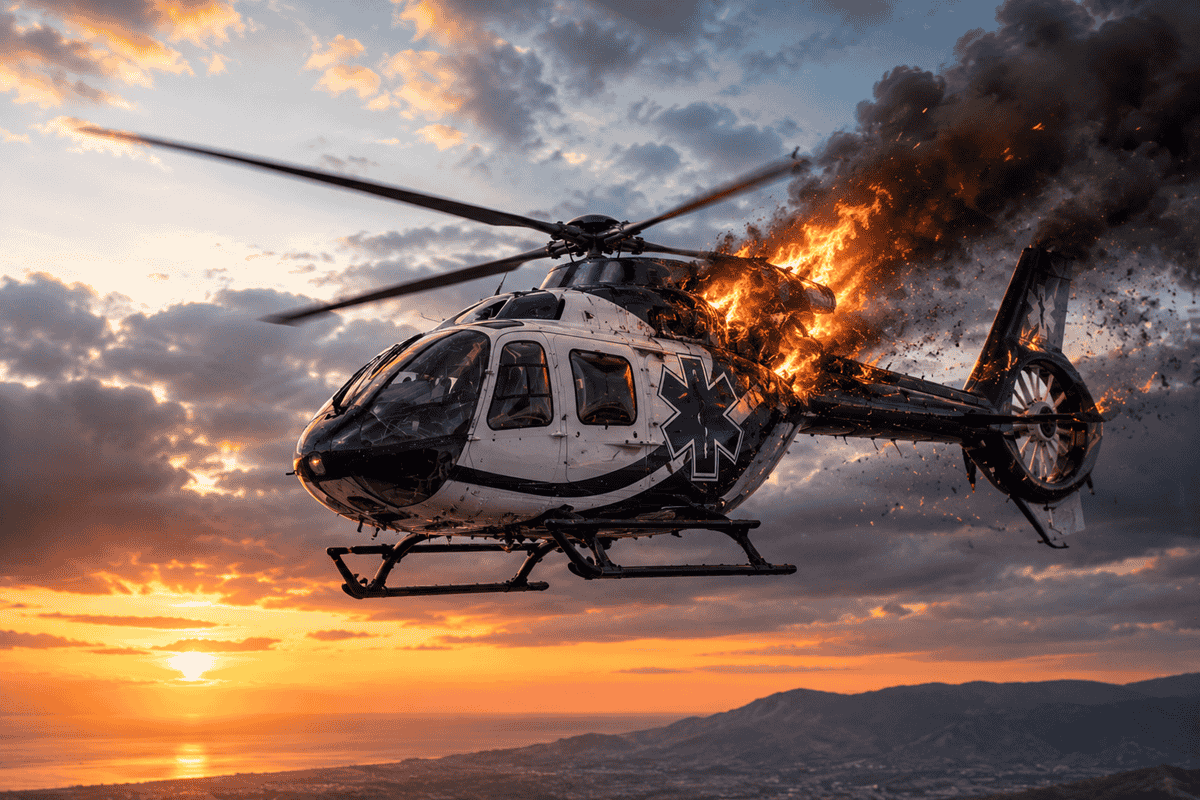
NTSB analysis found that post-crash fire significantly increased fatal outcomes in HEMS accidents. Structural integrity, fuel system design, and shutoff system reliability all affect whether an otherwise survivable impact becomes a fatality. Crew egress training adds the human layer to those engineering considerations.
These variables are not equally controllable, but they are not random either. Airframe selection, fuel system maintenance, and training program investment shape post-crash survivability outcomes in measurable ways.
“Two other operators had already said no to the same flight. The NTSB didn’t just find a bad decision; it found an organization where bad decisions were the path of least resistance.”
Human and Operational Factors Driving HEMS Accident Risk
Human factors appear in the vast majority of fatal HEMS accidents, but they rarely operate in isolation. Organizational culture, regulatory environment, and operational pressure shape the decisions that lead to a medical helicopter crash as much as any individual pilot’s choices do.
Pilot Decision-Making and Go/No-Go Pressure
The 2019 Survival Flight Bell 407 accident functions as a case study in safety culture breakdown. The pilot conducted the flight without an adequate preflight risk assessment. Two other operators had already refused the same mission for weather. The NTSB characterized Survival Flight’s safety culture as “inadequate” and described management as having “casual behavior regarding risk assessment”, language that does not appear in NTSB reports without substantial documentation.
Mission urgency is the cognitive mechanism. Knowing that a patient is waiting creates a documented bias toward launching in marginal conditions, a bias that safety management systems exist specifically to counteract. Without organizational structures that normalize refusal, the pressure defaults to “go.”
Fatigue and Shift Demands in Air Medical Operations
HEMS pilots often fly on-demand shifts with irregular rest patterns. Fatigue degrades precisely the decision-making and situational awareness skills most needed when weather or mechanical conditions deteriorate: the skills, in other words, that keep marginal conditions from becoming fatal ones.
Federal Aviation Administration (FAA) and NTSB attention has focused on consistent shift-change briefings and crew rest standards as organizational-level mitigations. Those are not pilot-level fixes because fatigue is not a pilot-level problem – it is a scheduling and culture problem that individual willpower does not reliably solve.
Single-Pilot Operations and Crew Resource Management
The NTSB has identified single-pilot crew configuration as a structural vulnerability in HEMS. The absence of a second pilot eliminates cross-check redundancy during the highest-workload phases: night approaches to unimproved landing zones, weather avoidance decisions, and emergency declarations that require simultaneous aircraft control and radio communication.
The gap is recognized by those closest to the issue. 88% of HEMS pilots surveyed by NEMSPA ranked a minimum required HEMS-specific pilot training curriculum as an important safety improvement. Industry-wide standards on training minimums have been inconsistent, which means operator quality varies considerably.
| Risk Factor | Contribution to Fatal HEMS Accidents | Primary Mitigation |
| Human error | 77% | SMS, go/no-go protocols, training standards |
| Weather (incl. IMC) | 30% | NVGs, HTAWS, dispatch weather tools |
| Obstacle strikes | 20% | HTAWS, route planning, NVGs |
| Mechanical failure | 17% | MRO quality, inspection currency, FDRs |
| Nighttime factors | 38.9% of fatalities | NVG adoption, night training requirements |
Safety Technologies Reducing Medical Helicopter Crash Risk
The HEMS safety record has improved materially since the late 2000s. Regulatory pressure, avionics technology adoption, and cultural change in flight risk management have all contributed, and the improvement is measurable in accident rates, not just in industry statements.
Night Vision Goggles (NVGs)
NVG adoption among U.S. HEMS operators rose from 2-5% in 2006 to over 90% today, representing one of the most significant safety inflection points in air medical history. NVGs amplify available light to allow obstacle detection and terrain awareness in conditions that previously required instrument flight certification and equipment most HEMS aircraft did not carry.
Training quality is the current limiting factor, not hardware availability. A 73% majority of HEMS pilots surveyed said NVG equipment should be mandatory for all night VFR operations. The remaining debate is about whether training standards are keeping pace with hardware deployment.
Helicopter Terrain Awareness and Warning Systems (HTAWS)
HTAWS directly addresses controlled flight into terrain, the accident type that accounts for 11% of light helicopter crashes, by providing audio and visual alerts when the aircraft approaches terrain or obstacles. Approximately two-thirds of HEMS operators now have HTAWS installed.
The limitation is important to understand: HTAWS warns of terrain, not weather. The 2013 Hospital Wing AS350B3 crash in Tennessee occurred in an aircraft equipped with both NVGs and HTAWS. Technology cannot substitute for weather go/no-go discipline, and no combination of cockpit tools changes that fundamental constraint.
Safety Management Systems and Flight Data Monitoring
SMS adoption provides an organizational framework for proactive hazard identification before accidents occur, rather than reactive analysis after they do. Flight operational quality assurance programs extend that capability with data: the NTSB has consistently recommended lightweight aircraft recording systems for HEMS fleets, and the absence of that data remains a genuine gap in both accident analysis and ongoing risk monitoring.
Automatic Dependent Surveillance–Broadcast (ADS-B) and satellite tracking add a real-time dimension, allowing dispatch and operations control centers to maintain situational awareness of aircraft position and performance in ways that were not operationally practical a decade ago. Sound helicopter operations management increasingly integrates these tracking tools into standard dispatch protocols.

What Ground Support Teams Can Do to Support HEMS Safety
The link between ground servicing quality and in-flight safety is less visible than cockpit technology, but it is real. Aircraft that depart with avionics anomalies introduced during ground servicing carry elevated risk into the operating environment where that risk matters most.
Proper pre-mission ground power is a direct line of protection. Using regulated, aviation-grade Ground Power Units (GPUs) during pre-flight systems initialization protects avionics from voltage spikes, dirty power, and ground loop interference that unregulated sources can introduce. This is particularly relevant for HEMS operations where pre-flight checks may occur on remote pads or in field conditions where power quality is not guaranteed.
Lithium-powered portable GPUs offer a specific operational advantage for HEMS: faster readiness, reliable peak current for full systems checks, and a lighter ramp footprint that matters on tight helipads. Rigorous helicopter maintenance programs increasingly specify GPU standards as part of avionics protection protocols, not just as a power-delivery convenience.
START PAC® supports HEMS operators and MRO teams with portable ground power units engineered for the power quality and reliability that air medical operations demand. When the aircraft needs to be ready, the ground equipment that prepares it needs to be equally dependable.
Conclusion
A medical helicopter crash is almost never the result of a single failure. It is the convergence of weather exposure, human decision-making under pressure, organizational risk culture, and mechanical readiness: factors that interact and amplify each other in ways that single-variable analysis misses.
The safety technologies and regulatory changes of the past two decades, NVGs, HTAWS, SMS adoption, have measurably improved outcomes. But the mission profile that makes HEMS valuable also ensures its risk can never be fully eliminated, only managed.
For operators and MRO teams, that means no layer is trivial. Dispatch protocols, aircraft systems integrity, pilot training currency, and the ground equipment that services the helicopter before it lifts all contribute to whether a flight returns safely. Explore START PAC®’s portable GPU solutions for HEMS and air ambulance operations, or contact the team for fleet-specific ground support recommendations.