
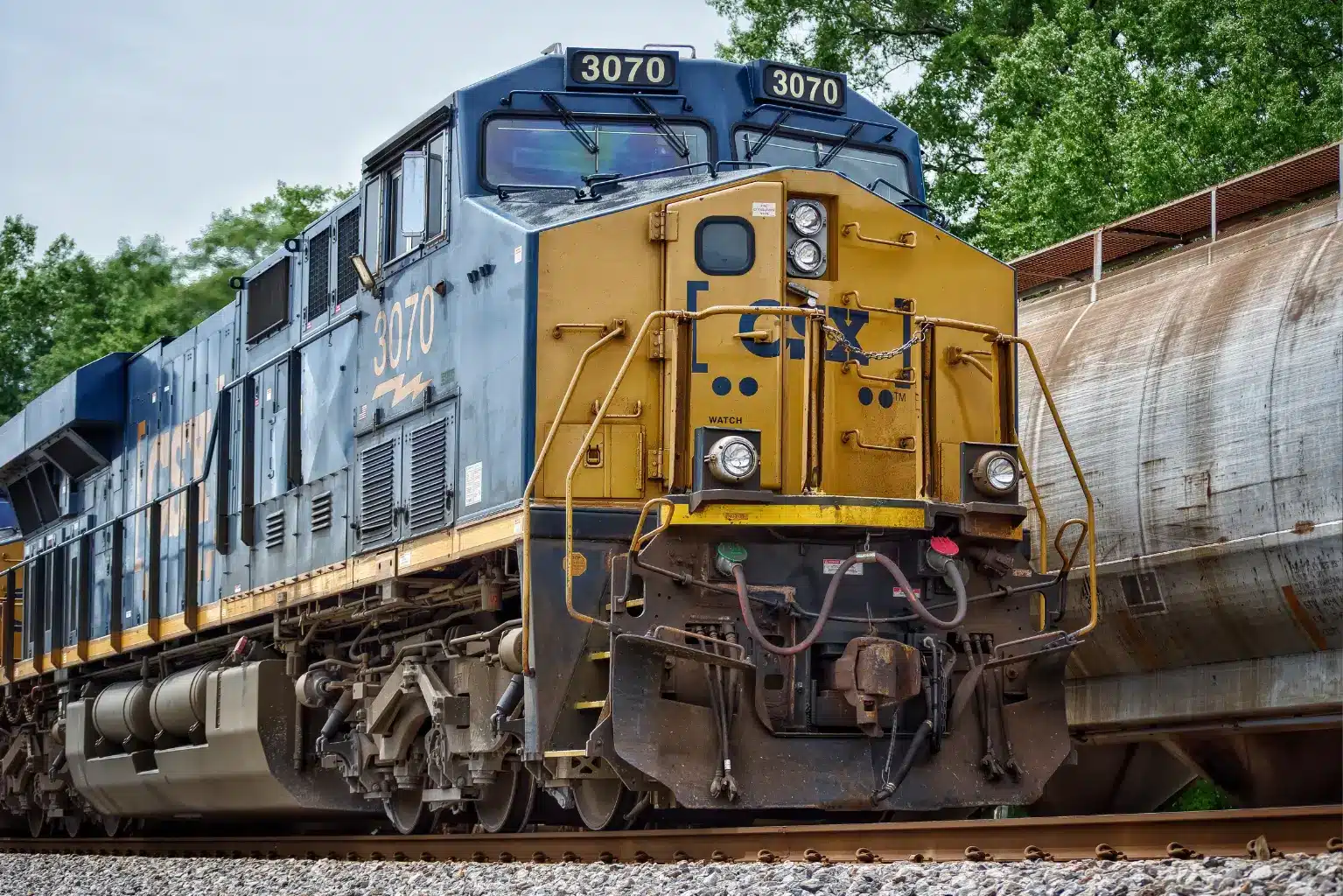
A single modern freight locomotive carries more diesel than most above-ground storage tanks at a typical gas station. Put three units together in a standard consist, and you have enough fuel to fill roughly 300 pickup trucks. That scale surprises most people outside of rail operations.
So, how much fuel does a locomotive hold? The honest answer spans a wide range: from around 600 gallons in a compact yard switcher to 5,500 gallons in a heavy-haul freight unit. That gap isn’t random. It reflects a deliberate engineering decision tied entirely to what the locomotive is built to do.
Rail fleet managers, MRO teams, locomotive mechanics, and equipment procurement professionals need accurate capacity benchmarks, not ballpark figures borrowed from the wrong locomotive class. The sections below cover capacity by locomotive type, the variables that drive the differences, consumption rates, refueling logistics, and the ground equipment that keeps locomotives ready to move between fuel stops.
What Determines Locomotive Fuel Tank Size?
Tank capacity is not arbitrary. It is engineered around three core variables: mission profile, horsepower output, and underframe design constraints.
Mission profile is the dominant factor. A mainline freight locomotive may run 1,000 or more miles between classification yards, so its tank must support that range. A switcher, by contrast, never leaves the yard. It has constant access to yard fueling infrastructure and makes short, repetitive movements all shift long.
Horsepower output shapes the equation from the consumption side. Higher-HP units burn more fuel per hour at working throttle, which means the tank must be proportionally larger just to cover the same distance. Underframe design adds a physical ceiling: the tank sits between the power trucks, and that space limits maximum volume regardless of how much capacity the operator would prefer.
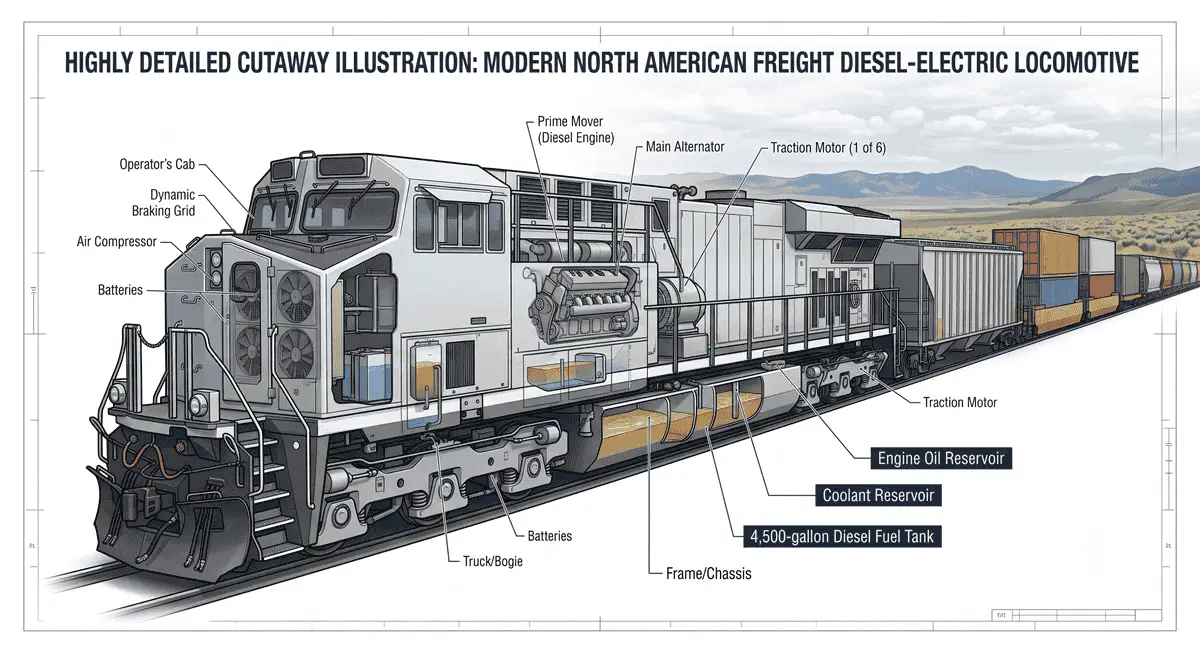
Owner preference and route economics add a final layer. Extra tank capacity reduces refueling stops, which saves time and labor. But added fuel weight increases baseline consumption slightly and raises acquisition cost. The practical planning benchmark used across the industry: 4,000–5,000 gallons for modern heavy freight, scaled down from there by service type.
Fuel Tank Capacity by Locomotive Type
Capacity ranges vary significantly across the four primary locomotive service categories. The figures below represent standard production configurations, though individual road modifications are possible on any unit. Understanding these ranges is the starting point for any honest answer to “how much fuel does a locomotive hold.”
Heavy Freight Road Locomotives
These units carry the largest diesel tanks in regular North American service. Modern heavy-haul freight locomotives typically hold 4,000–5,500 gallons in their underbelly fuel tank, plus separate reservoirs for approximately 300 gallons of coolant and 250 gallons of engine oil.
Wabtec (GE) Tier 4 freight models exceed 5,000 gallons in standard configuration. EMD SD70 series units typically run 4,000–5,000 gallons. The figure of 4,500 gallons per unit is the planning standard widely used in locomotive fueling problem (LFP) modeling across the industry.
At a consumption rate of 3.5 gallons per mile, a 4,000-gallon tank supports approximately 1,000–1,100 road miles between refueling stops under typical load conditions. That range covers most mainline segments between major classification yards without requiring an unplanned stop.
Passenger Locomotives
Passenger service runs on fixed schedules with planned station stops and pre-positioned refueling points. That predictability reduces the need for maximum tank capacity, and passenger locomotive tanks reflect it.
Amtrak’s P42DC Genesis locomotives hold 2,200 gallons, sufficient for routes where fuel stops are scheduled into the operating plan. The EMD F40PH, a workhorse of commuter and intercity passenger corridors, carries 1,500–1,800 gallons.
One exception stands out: Siemens Charger locomotives used in state-supported western corridor service hold up to 6,000 gallons, driven by long distances between fueling infrastructure rather than by horsepower demands.
Switcher and Yard Locomotives
A yard switcher is a different animal entirely. It operates within a classification yard or industrial siding, making short moves, coupling and decoupling cars, and rarely running at sustained throttle. Large tanks are unnecessary because yard fueling is always nearby.
Standard yard switcher capacity runs 600–1,100 gallons for most production units, with older EMD SW and GP switcher variants ranging 500–2,000 gallons depending on model and era. The more pressing fuel concern with switchers isn’t tank size. Switchers spend a documented 55–90% of daily operating time at idle, making idling inefficiency a persistent and measurable cost management challenge regardless of tank capacity.
Mid-Range and Regional Road Units
Four-axle road units and regional mainline locomotives fall between switcher and heavy freight capacity, generally holding 2,000–3,000 gallons. The older EMD SD40-2, the standard North American freight workhorse for decades, held 3,200–4,000 gallons depending on configuration.
Regional operators frequently accept lower tank capacity in exchange for lower acquisition cost. When routes include planned intermediate refueling stops, a smaller tank is a reasonable trade rather than an operational limitation.
The tank size isn’t about how much fuel a railroad wants to carry; it’s about how far the locomotive needs to go before it can stop.
How Much Fuel Does a Locomotive Burn?
Capacity answers how much a locomotive holds. Consumption rate determines how long that fuel lasts. Together, the two variables define every refueling interval planning decision in rail operations.
Fuel Consumption Under Load
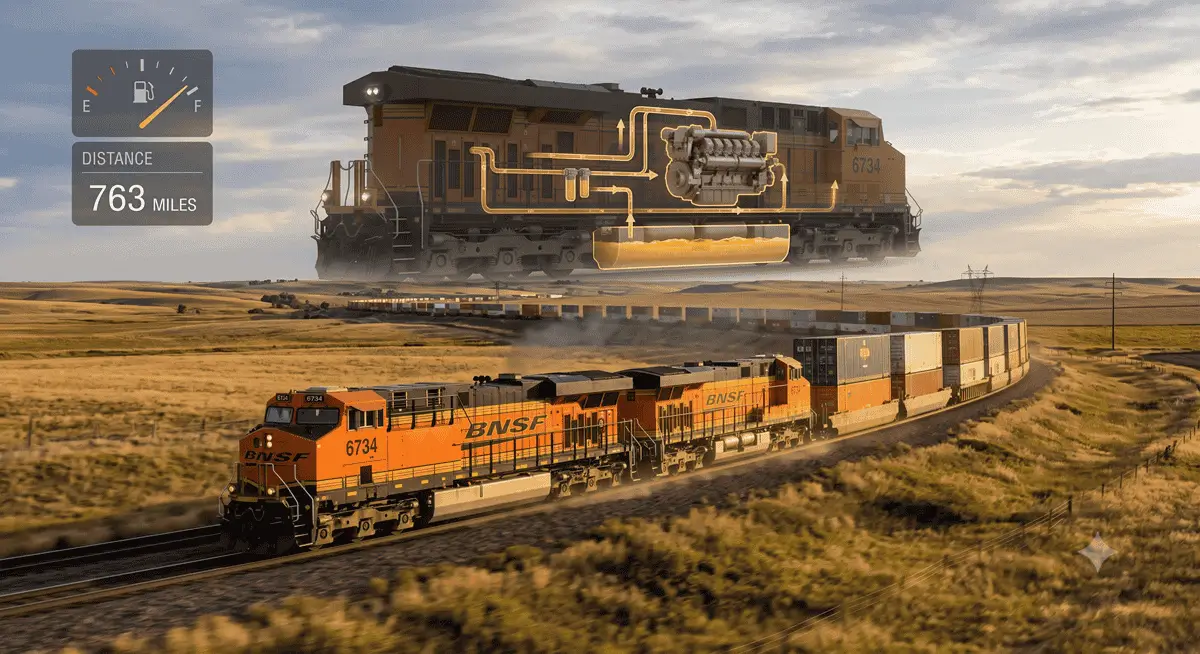
A heavy freight locomotive burns approximately 3.5 gallons per mile under typical loading and operating conditions. At that rate, a 4,500-gallon tank provides roughly 1,285 road miles of range before the tank approaches the minimum operating level.
Consumption is not linear, and treating it as such leads to miscalculated refueling intervals. Grade, tonnage, speed, and throttle notch position all affect burn rate significantly. Mountain territory with heavy tonnage can double per-mile consumption compared to level track at the same speed. High-horsepower units climbing at full throttle can consume far more than the per-mile average, sometimes within a single subdivision.
Idling Fuel Costs – A Major Operational Drain
A stationary diesel locomotive is not a fuel-neutral machine. At idle, a locomotive burns approximately 3.5 gallons per hour to maintain engine temperature, charge batteries, and power head-end power (HEP) systems.
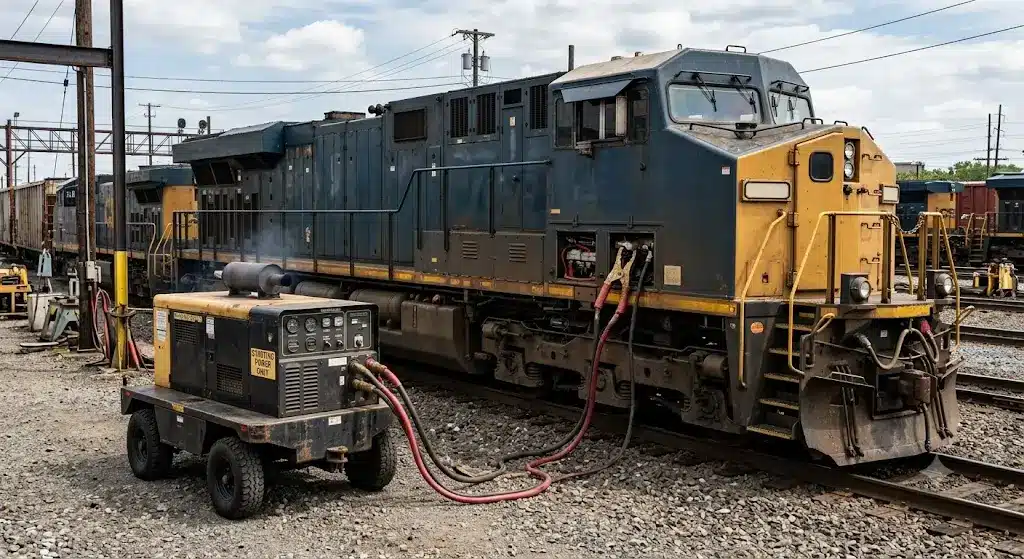
A switcher idling through a full 24-hour period can consume 300 or more gallons compared to roughly 95 gallons for an older, lower-idle unit. Scale that across a fleet: a railroad running 4,000 operational locomotives and consuming 500 million gallons of diesel annually can burn over 20 million gallons in excess idle, representing more than 4% of total fuel consumption. Automatic Engine Stop-Start (AESS) systems attempt to reduce this, but excessive engine cycling introduces starter system wear, and a reliable locomotive jump starter becomes an essential part of any yard’s ground support kit as a result.
Overall Rail Fuel Efficiency
To put locomotive fuel consumption in context, train fuel efficiency allows trains to haul one ton of freight approximately 480 miles on a single gallon of diesel, making rail 3–4 times more fuel efficient than trucks on a ton-mile basis.
That efficiency advantage is exactly why fuel management is a top-line cost driver for every Class I railroad. Accurate tank capacity knowledge and optimized refueling scheduling aren’t administrative details. They’re margin decisions made at scale.
Locomotive Refueling: How It Works in Practice
Fueling a heavy freight locomotive takes approximately 15 minutes at a mainline fueling facility, a sharp contrast to the hours required for alternative-fuel locomotives using pressurized gas systems. Classification yards maintain high-flow fueling infrastructure: inbound fuel skids, air eliminator tanks, and rail yard data management (RYDM) systems that monitor fuel levels digitally, detect leaks, and track consumption across the entire fleet.
Mobile servicing units can bring fuel, oil, water, and sand directly to a locomotive anywhere on the property. That eliminates the need to cut and move the unit to a service pit, saving significant labor time and reducing the operational disruption of pulling a locomotive out of a consist.
Refueling interval planning begins with knowing tank capacity accurately. The locomotive fueling problem is a documented optimization challenge in rail operations. Miscalculated capacity leads to unplanned fuel stops mid-route or deadhead moves to service facilities, both of which carry real cost.
| Locomotive Type | Typical Tank Capacity | Approx. Range at 3.5 gal/mile |
| Heavy Freight Road Unit | 4,000–5,500 gallons | 1,000–1,400 miles |
| Passenger (P42DC) | 2,200 gallons | ~600 miles |
| Siemens Charger | Up to 6,000 gallons | ~1,700 miles |
| Regional / Mid-Range | 2,000–3,000 gallons | 550–850 miles |
| Yard Switcher | 600–1,100 gallons | Short / yard use only |
When Fuel Isn’t the Issue: Locomotive Starting and Ground Power
A full fuel tank does nothing if the locomotive won’t start. In rail yards, a locomotive with a depleted or failed starting battery is a traffic disruption and a direct productivity loss – the kind that cascades into delayed consists and missed windows.
Locomotive starting systems require high-current DC power to crank diesel engines ranging from hundreds to thousands of horsepower. When the onboard battery system cannot deliver that current, an external jump starter or ground power units are the solution. The locomotive power supply equipment START PAC® builds for rail applications is rated for engines up to 6,000 horsepower. The 3324RR™ unit handles engines up to 3,500 HP and is built for rough yard terrain with solid rubber wheels and heavy-duty alligator clips designed to hold under high-current load.
The parallel to aircraft ground operations is direct. Just as a GPU keeps a turbine aircraft’s avionics and battery systems healthy between flights, a locomotive starting unit keeps rail rolling stock ready for immediate service without depending solely on onboard battery state. Batteries degrade in cold weather, lose charge during extended idle shutdowns from AESS systems, and fail under the cumulative demand of repeated cold cranks.
Keeping locomotives on the tracks and on schedule requires both a full tank and a reliable path to starting that engine when it matters. Neither element substitutes for the other.
Conclusion
How much fuel does a locomotive hold ranges from roughly 600 gallons in a yard switcher to 5,500 gallons in a heavy freight road unit. That range is determined by mission profile, horsepower output, and the fueling infrastructure available along the route.
For rail fleet managers and MRO teams, accurate capacity knowledge is the foundation of refueling interval planning, fuel cost management, and operational continuity. Estimating with a round number or borrowing a figure from a different locomotive class introduces compounding errors in scheduling and procurement.
The fuel tank gets the locomotive down the line. The starting system gets it moving in the first place. Both deserve the same level of operational attention and the same quality of ground support equipment.
Explore START PAC®’s locomotive jump starter and ground power solutions, or contact the team directly for equipment recommendations matched to your fleet’s specific horsepower range.